A Complete Guide to Your Removable Orthodontic Retainer
You’ve done it. After months of dedication, your braces or aligners are off, and your new, straight smile is finally here. But the journey isn’t quite over. Now comes the most important part of the whole process: making sure that smile lasts a lifetime. This is where a removable orthodontic retainer comes in.
Think of it as the guardian of your new smile. It’s a custom-made appliance designed specifically to hold your teeth in their perfect new positions after treatment. Wearing it exactly as your dentist recommends is the single most important thing you can do to protect the time and money you’ve invested.
Why Your Smile Depends on a Removable Retainer
Once your braces come off, your teeth have a natural memory and a tendency to drift back to where they used to be. This frustrating process is called orthodontic relapse, and it’s surprisingly common.
Imagine your teeth have just been moved into a new neighbourhood. The surrounding bone and ligaments are a bit like soft soil that needs time to firm up around them. Your retainer acts as a scaffold, holding everything securely in place while the foundations solidify. Without it, the everyday pressures of chewing and talking can slowly but surely nudge your teeth out of alignment.
Preventing Orthodontic Relapse
Don’t underestimate the power of a retainer. It’s your best line of defence against your teeth shifting. For anyone who has used clear aligners, like those from Toothfairy, wearing your retainer is absolutely non-negotiable to lock in your results.
The evidence is clear: studies consistently show that proper retainer use can prevent a massive 70-90% of relapse risk. It’s the key to a long-term straight smile. Fortunately, getting a perfectly fitting retainer is simpler than ever, thanks to the widespread use of digital scanning in UK dental clinics. This technology is a big reason why the European market for removable retainers was valued at USD 0.45 billion in 2024 and continues to grow. You can explore the data behind these market trends to see just how vital they’ve become.
“Forgetting to wear your retainer is like building a beautiful house and then leaving the doors and windows open. It leaves your hard-earned results vulnerable to the natural forces that want to undo your progress.”
A Modern Approach to Smile Protection
The great news is that keeping your smile straight doesn’t have to mean endless trips back to the dentist. Modern retention plans are designed to fit around your life, not the other way around.
This is where services like Toothfairy are changing the game. We’ve built virtual care right into the process, giving you a smarter, more affordable way to protect your smile. Through our app, you get:
- Expert Oversight: A qualified UK dentist can check on your progress from afar, making sure your retainer is working as it should.
- On-Demand Support: Got a question? Worried about a crack? You can connect with a dental professional right from your sofa.
- Affordable Replacements: Lost or broke your retainer? Ordering a new one is straightforward, saving you the time and expense of a traditional clinic visit.
By blending professional dental expertise with the convenience of technology, Toothfairy helps ensure your fantastic new smile is truly built to last.
Choosing Between Clear and Hawley Retainers
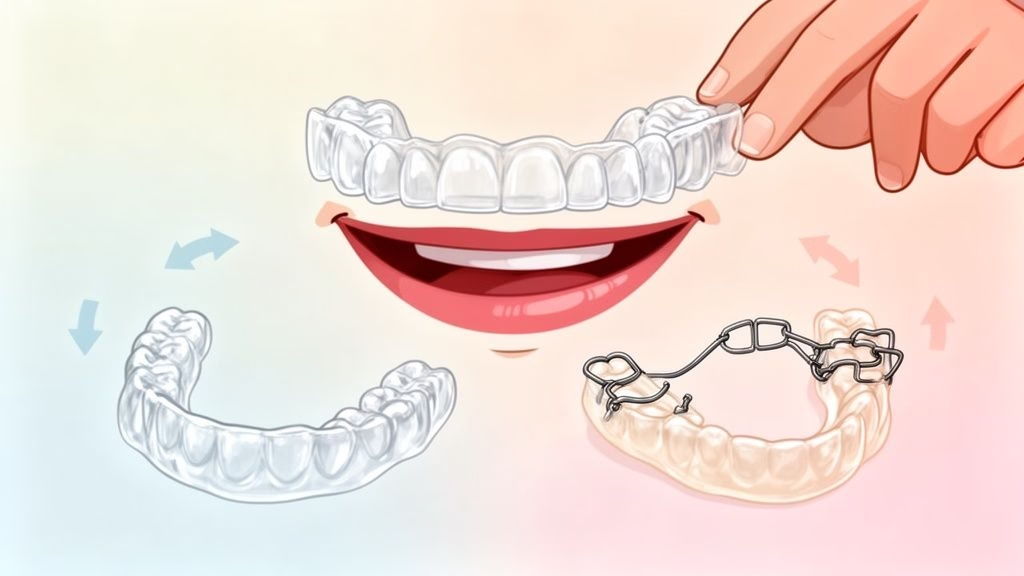
When people talk about a removable orthodontic retainer, they’re usually thinking of one of two classic designs. Each one has its own set of pros and cons, and they fit different lifestyles. Getting to know them is the first step in having a proper chat with your dentist about which is right for you.
The choice really boils down to a modern, discreet option versus a durable, time-tested classic. Let’s break down the two most common types to see how they stack up.
The Discreet Choice: Clear Retainers
A clear retainer, often known as an Essix-style retainer, is a thin, see-through tray that fits snugly over your teeth. It’s custom-moulded from a tough plastic to hold every single tooth perfectly in its new place.
Their biggest selling point is their appearance – they’re practically invisible. This makes them a hugely popular choice, particularly for adults who’ve just finished treatment with clear aligners. If that’s you, the switch feels completely natural, as the look and feel are almost identical to what you’re used to.
- Aesthetics: So discreet, you can wear them without anyone really noticing.
- Comfort: The smooth plastic finish is generally very comfortable against your tongue and cheeks.
- Protection: Because they cover the entire chewing surface, they offer a degree of protection against nighttime teeth grinding.
This modern approach has become the go-to for many people. It fits perfectly with the convenient, patient-first care we provide at Toothfairy, where we offer high-quality clear retainers as an affordable and smart way to protect your results.
The Durable Classic: Hawley Retainers
The Hawley retainer is the one you probably picture from films and TV shows. It’s made of a hard, custom-moulded acrylic plate that sits against the roof of your mouth (or inside the lower teeth), combined with a thin metal wire that runs across the front of your teeth.
While it’s definitely not as subtle as a clear retainer, the Hawley is famous for its incredible durability. If you look after it properly, it can last for years and years—sometimes even a decade or more.
Another huge benefit is its adjustability. If a little bit of tooth movement happens down the line, an orthodontist can often tweak the wire to gently nudge teeth back into alignment. That’s something you simply can’t do with a clear plastic retainer.
“Choosing a retainer is about balancing aesthetics with functionality. While clear retainers offer near-invisibility, the robust and adjustable nature of a Hawley retainer makes it a reliable choice for long-term smile maintenance.”
To help you weigh your options, here’s a quick side-by-side comparison of the key differences between these two popular retainers.
Comparing Clear vs Hawley Removable Retainers
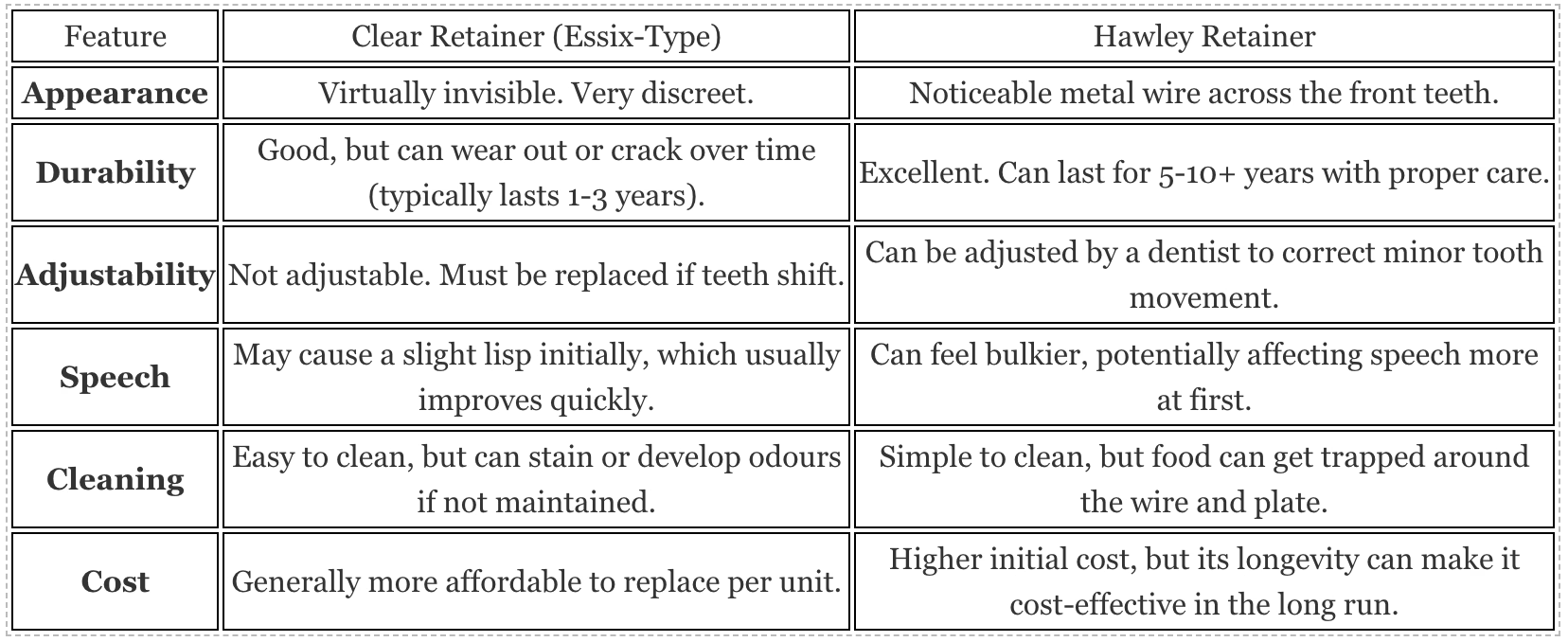
Ultimately, the best retainer comes down to what you prioritise. The growing preference for removable options is a huge trend in UK orthodontics. Removable retainers hold nearly 44% of the market share, a figure boosted by a 20%+ increase in adults seeking orthodontic treatment over the last five years. Many of these adults, having used clear aligners, naturally lean towards clear retainers afterwards. You can dive deeper into these trends and explore the orthodontic market segmentation at Reanin.com.
So, what’s more important to you? Is it discretion and a familiar feel, or maximum durability and the peace of mind that comes with adjustability? Talking this through with your dentist is the best way to ensure you pick the perfect guardian for your smile.
Your Daily Guide to Retainer Care and Maintenance
So, you’ve got your new retainer. That’s fantastic! It’s your ticket to keeping that perfectly straight smile you’ve worked so hard for. But just like any precision instrument, it needs a bit of looking after to do its job properly.
Think of it this way: a simple daily routine is the best insurance policy for your teeth. Let’s walk through exactly what you need to do to keep your retainer (and your smile) in top-notch condition for years to come.
Your Wearing Schedule From Day One
When your braces first come off, your orthodontist will hand you your retainer along with a very specific set of instructions. It’s absolutely vital you stick to this plan.
For the first few months, you’ll likely be asked to wear your retainer full-time. This means it only comes out when you’re eating, drinking anything besides plain water, or brushing your teeth. This intensive phase is crucial because the bone and tissues around your teeth are still settling down and need that constant support to firm up in their new positions.
After that initial period, you’ll usually get the green light to switch to nightly wear for life. I know “for life” sounds like a huge commitment, but it quickly becomes second nature – just another part of your bedtime routine, like brushing your teeth. Sticking to this is the single most important thing you can do to stop your teeth from moving back.
Perfecting Insertion and Removal
Learning to handle your retainer correctly is a simple skill that will save you a lot of hassle and potential damage down the line.
- Putting it in: Always use your fingers to gently guide the retainer onto your teeth. For the top one, I find it easiest to push up on the back molars first, then click it into place over your front teeth. For the bottom, seat it over the front teeth first and then press down at the back.
- Taking it out: The trick is to loosen it from the back. Use your fingertips on both sides to gently pull down on the edge near your molars (for the top retainer) or lift up (for the bottom). Try not to yank it from the front arch, as this can bend the wire or warp the plastic over time.
And please, never bite your retainer into place! It’s a sure-fire way to cause tiny fractures or even snap it.
Ever forgotten to wear your retainer for a night and noticed it feels really tight the next day? That tightness is a warning sign. It means your teeth have already started to shift. Consistent nightly wear is the only way to keep them exactly where they should be.
Keeping Your Retainer Clean and Fresh
Good hygiene is non-negotiable. A dirty retainer doesn’t just look and smell bad; it becomes a breeding ground for bacteria that can cause bad breath, plaque, and even affect your oral health.
Here’s a dead-simple cleaning routine that works a treat:
- Rinse Immediately: The moment you take it out, give it a quick rinse under cool or lukewarm water. This gets rid of saliva and food particles before they have a chance to dry on and harden.
- Gentle Brushing: Use a soft-bristled toothbrush (keep one just for your retainer) and a bit of non-abrasive soap or washing-up liquid to give it a gentle scrub. Avoid toothpaste, as it can be surprisingly abrasive and create tiny scratches where germs love to hide.
- Rinse Thoroughly: Once it’s clean, rinse it well under cool water to wash away all the soap.
One crucial tip: never, ever use hot water. It will warp the plastic in a heartbeat, completely ruining the custom fit and making your retainer useless.
If you’re ever unsure about your routine or feel like something’s not quite right, getting professional advice is easier than you think. An app like Toothfairy lets you have a quick video chat with a UK-registered dentist. It’s a great way to get answers on retainer care or even set up reminders, giving you a bit of backup to keep your smile on the right track.
Comparing Removable Retainers with Fixed Retainers
So, you’ve done the hard work and your teeth are finally straight. Fantastic! But the journey isn’t quite over. Now comes the crucial decision of how to keep them that way, which usually boils down to choosing between a removable retainer and a fixed one.
A fixed retainer, often called a bonded or permanent retainer, is a very fine wire that your dentist cements to the back of your front teeth. It’s always there, working 24/7, which sets up an interesting choice between two very different philosophies for protecting your new smile.
The Trade-Off Between Convenience and Control
Perhaps the biggest difference between the two is how much they rely on you. A removable orthodontic retainer gives you all the control, but it also demands the discipline to actually wear it as your dentist tells you to.
A fixed retainer, on the other hand, is the ultimate ‘set-it-and-forget-it’ option. Since it’s bonded in place, you can’t lose it, and you don’t have to remember to put it in. For anyone who worries about being forgetful, this is a massive plus.
The choice between fixed and removable retainers isn’t about which is “better” overall, but which is better for you. It’s a balance between the freedom of a removable device and the constant security of a fixed one.
Hygiene and Oral Health Considerations
Your daily cleaning routine is another major factor. With a removable retainer, keeping your teeth clean is simple. You just pop it out, then brush and floss exactly as you did before, with nothing getting in the way.
Cleaning around a fixed retainer takes a bit more finesse. That bonded wire makes flossing a real challenge, meaning you’ll need tools like a floss threader or special interdental brushes to get underneath it. It’s doable, but if you slack off, plaque can easily build up and lead to gum trouble.
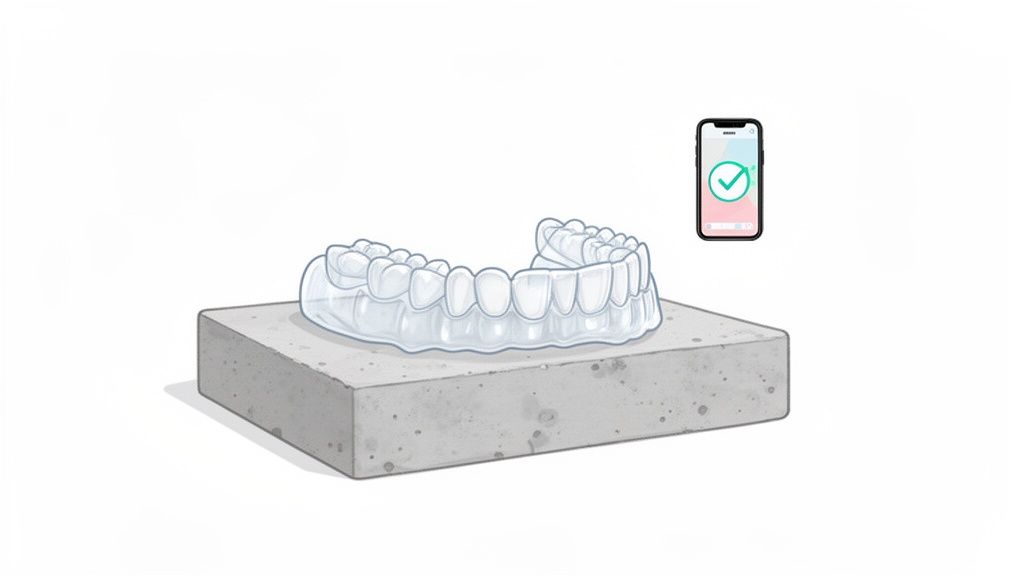
This handy guide helps you visualise the simple steps for caring for your removable retainer.
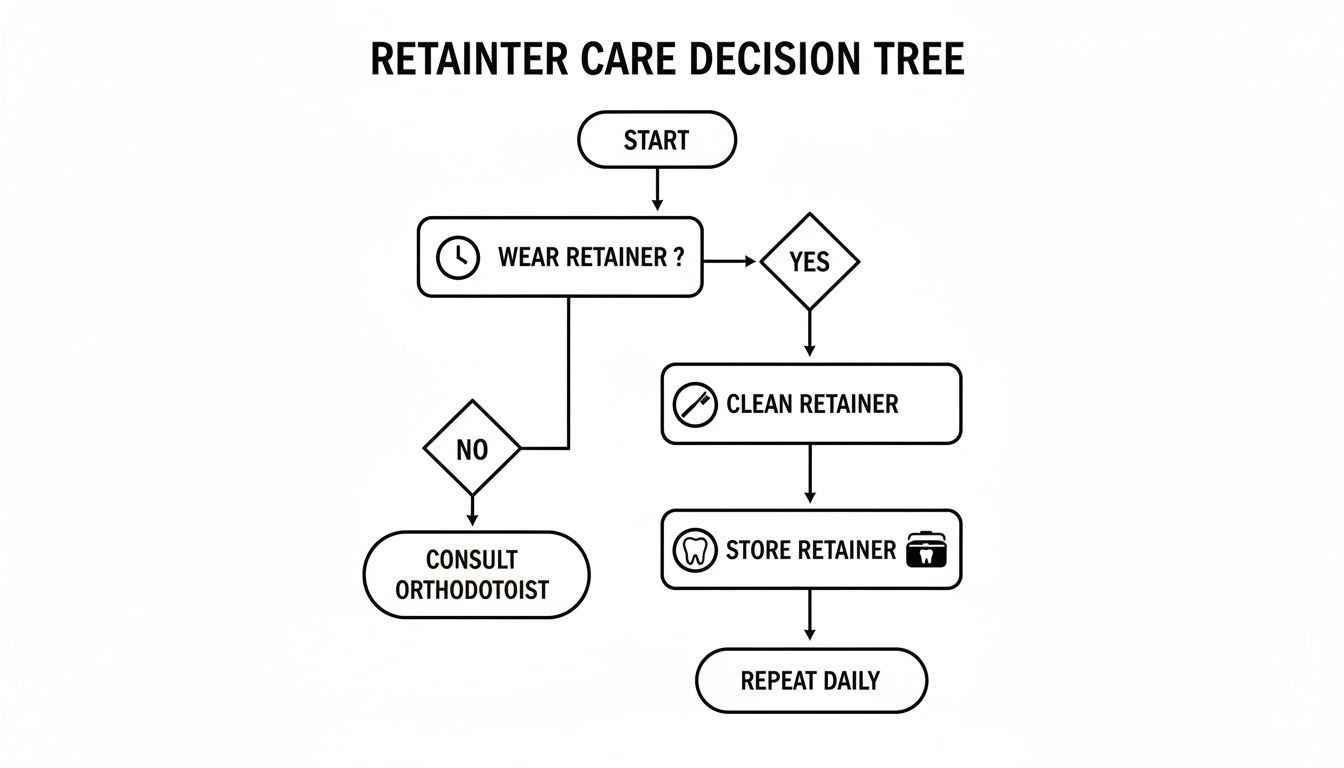
This flowchart shows just how straightforward the routine is for keeping both your retainer and your smile in top condition.
Finding the Perfect Solution for Your Smile
At the end of the day, there’s no clear winner in the fixed vs. removable debate. The best choice really depends on your teeth, your lifestyle, and your personality. It’s also worth noting how your initial treatment—like comparing a specific clear aligner brand vs. traditional braces—can influence what kind of retainer works best for you afterwards.
In fact, many orthodontists now suggest a hybrid approach for the best possible protection. This often looks like a fixed retainer on the lower front teeth, which are notorious for shifting, combined with a removable retainer for the upper teeth.
This “belt and braces” strategy gives you the best of both worlds. At Toothfairy, we’re all about finding the plan that fits you perfectly. A quick video consultation with one of our dentists can help you work out the smartest way to protect your investment and keep that perfect smile for years to come.
Keeping Your Retainer in Shape: Lifespan and Costs
So, you’ve finished your orthodontic treatment and you’ve got your removable retainer. The two big questions on everyone’s mind are pretty simple: how long is this thing going to last, and what’s it going to cost me to replace it? Knowing the answers helps you plan ahead and keep that smile you worked so hard for.
A retainer isn’t a one-and-done purchase. I like to compare it to a good pair of walking boots – they’re built tough for daily wear and tear, but eventually, they’ll need replacing to keep doing their job properly.
How Long Can You Expect Your Retainer to Last?
Honestly, this really comes down to which type you have and how well you look after it. Your personal habits make a huge difference, too. For instance, if you clench or grind your teeth at night (a condition known as bruxism), you’ll put your retainer under a lot more stress.
- Hawley Retainers: These are the workhorses of the retainer world. Built from a sturdy combination of acrylic and metal wires, a well-cared-for Hawley can easily last 5 to 10 years, and sometimes even longer. They’re incredibly durable.
- Clear (Essix-style) Retainers: These are fantastic for their near-invisible appearance, but they aren’t quite as tough. Think of them as high-performance trainers – they do a great job but wear out faster. You’ll typically need to replace them every 1 to 3 years as they can get worn down, develop small cracks, or become discoloured.
Grinding your teeth, in particular, can really shorten the lifespan of a clear retainer, sometimes causing holes to appear. That’s why it’s so important to replace it when it’s worn out, to make sure your teeth stay put.
A damaged or worn-out retainer simply can’t hold your teeth in place effectively. Using one is like trying to keep a gate closed with a rusty latch – it might look like it’s working, but it offers no real security, leaving your teeth at risk of shifting back.
The Cost of a Replacement Retainer in the UK
The price tag for a new retainer can vary quite a bit, depending on whether you go through the NHS or a private dental practice. The cost isn’t just for the retainer itself; it usually includes the appointments, the dentist’s time, and taking new impressions of your teeth.
The old-school way of getting a replacement involved booking an appointment, travelling to the clinic for moulds, and then going back again for a final fitting. All those steps add up in both time and money. Privately, you could easily be looking at a bill of anywhere from £100 to over £250 for a single retainer.
A More Sensible (and Affordable) Way to Protect Your Smile
This is where a more modern approach can be a real game-changer, saving you a lot of hassle and cash. At Toothfairy, we’ve rethought the whole process by getting rid of the costly and time-consuming clinic visits, which makes looking after your smile much more straightforward and affordable.
We use a digital platform to put you in touch with UK-registered dentists who can prescribe and send you a new, custom-made removable orthodontic retainer without you ever having to leave your house. It’s as simple as this:
- Talk to a Dentist from Home: Jump on an on-demand video call with a dentist to discuss what you need, all from the comfort of your sofa.
- Take Your Own Impressions: We’ll post you an impression kit with easy-to-follow instructions. You take the moulds of your teeth yourself – no clinic trip needed.
- Delivered to Your Door: A dental lab will craft your new retainer to fit perfectly, and we’ll deliver it right to you.
This streamlined model doesn’t just make life easier; it brings the cost down significantly. It empowers you to take control of your long-term smile care, protecting your investment without the hefty price tag. With Toothfairy, you’re getting the same professional, high-quality retainer you’d get from a traditional clinic, but in a way that actually fits into a modern, busy life.
How to Handle Common Retainer Problems
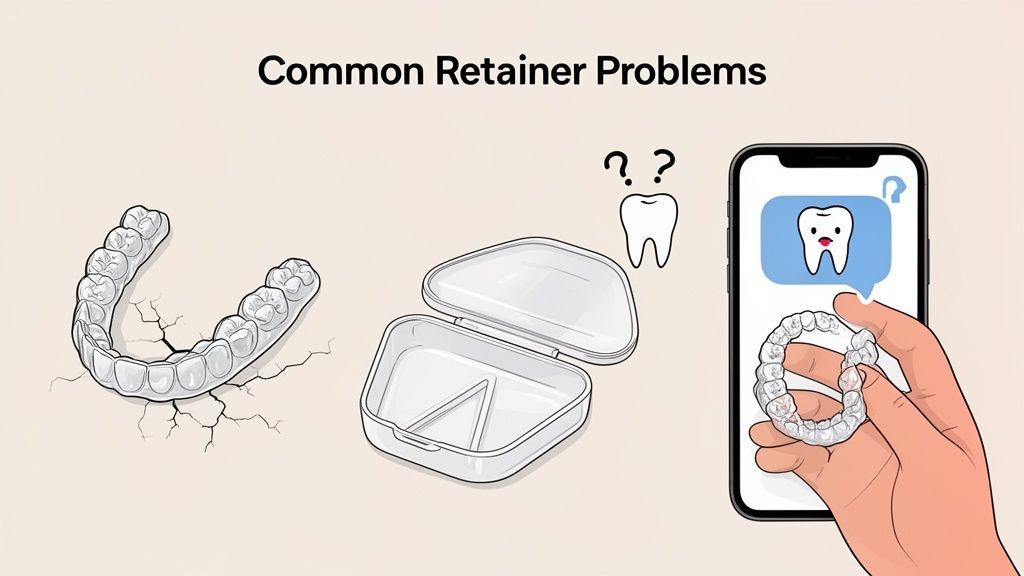
Even with the best intentions, life sometimes gets in the way. Your removable orthodontic retainer might go missing, get damaged, or just start feeling off. Knowing how to react when these little dramas unfold can save you a lot of stress and, crucially, stop your teeth from undoing all your hard work.
The golden rule for any retainer-related issue is simple: act quickly. Every day you go without your retainer is a day your teeth can start shifting back to where they used to be. Don’t panic, but don’t delay either.
What to Do If Your Retainer is Lost or Broken
It’s a heart-sinking moment, isn’t it? You search everywhere, but it’s gone. Or you pick it up and notice a crack. A broken retainer simply can’t do its job properly, and a lost one leaves your smile completely vulnerable.
Your first move should always be to get in touch with a dental professional straight away. It’s tempting to wait and see what happens, but trust me, your teeth will start to move. The longer you wait, the more they’ll shift, and you could end up needing more orthodontic work to fix it.
This is where modern dental care can be a real lifesaver. Instead of waiting days for an appointment, services like Toothfairy offer on-demand video consultations. You can get straight through to a UK-registered dentist, explain the problem, and get a replacement sorted out in no time.
“A lost or broken retainer is a dental emergency for your smile’s alignment. The faster you act to get a replacement, the more likely you are to prevent orthodontic relapse and protect the investment you’ve made in your teeth.”
Having that instant access to a professional takes the panic out of the situation and offers a much smarter, more affordable way to handle unexpected dental issues.
When Your Retainer No longer Fits Properly
Another common headache is when your retainer suddenly feels incredibly tight, or the opposite—so loose it won’t stay put. This is a clear sign that something is amiss.
Here’s a quick breakdown of what might be going on:
- It feels too tight: This is the most frequent complaint and it almost always means you haven’t been wearing your retainer as much as you should. That tight feeling is the retainer literally pushing your teeth back into line. If you can still get it in, try wearing it full-time for a day or two. You should feel the pressure ease as your teeth settle back into place.
- It won’t fit at all: If you physically can’t get the retainer over your teeth, it’s a red flag. It means your teeth have already shifted too far. Whatever you do, don’t try to force it, as you could damage both your teeth and the retainer. You need to call a dentist immediately.
- It feels loose: A loose retainer is doing nothing to protect your smile. This can happen over time as the plastic warps or stretches. It needs replacing.
For any of these scenarios, getting professional advice is non-negotiable. A quick virtual chat with a dentist on Toothfairy can help you figure out what’s wrong and what to do next, whether it’s getting back on track with your wear schedule or ordering a new, perfectly fitted removable orthodontic retainer.
Your Questions Answered: Living with a Removable Retainer
Even after getting all the details, you probably have a few practical questions about day-to-day life with your removable orthodontic retainer. Let’s tackle some of the most common ones we hear from our patients.
Can I Eat or Drink with My Retainer in?
It’s a definite no for eating. Food will inevitably get trapped between your retainer and your teeth, creating a perfect breeding ground for plaque. It’s not just bad for your teeth; it can also damage the retainer itself.
When it comes to drinks, the only safe bet is plain, cool water. Anything else—sugary sodas, acidic fruit juices, or hot tea and coffee—can cause problems. Sugars and acids get trapped against your enamel, raising the risk of cavities, while hot liquids can warp the plastic, ruining the fit for good.
Is It Normal for My Retainer to Feel Tight?
Yes, a bit of snugness is completely normal. In fact, it’s a good sign! That slight pressure means the retainer is doing its job, gently holding your teeth in place and stopping them from shifting.
You’ll especially notice this if you’ve forgotten to wear it for a night. However, if the tightness turns into sharp pain or you’re really struggling to get it in, something isn’t right. That’s when you should speak to a dentist. A quick Toothfairy video consultation is a great way to get a professional to check the fit without you having to leave home.
How Often Should I Replace My Retainer?
Keep an eye out for a few tell-tale signs. You’ll need a new removable orthodontic retainer if you spot any cracks, notice it’s become permanently cloudy (even after cleaning), or if it feels loose. A loose retainer simply isn’t working anymore, leaving your hard-earned straight smile unprotected.
As a rule of thumb, a clear plastic retainer typically lasts between one and two years. This can vary depending on how well you care for it and whether you grind your teeth at night.
When you’re looking for a new dentist or orthodontist, it’s always wise to check their patient feedback. Many top practices now use online reputation management for dentists to showcase their quality of care. With Toothfairy, you can skip the search and order a new, perfectly fitted replacement directly.
Can a Retainer Straighten My Teeth Again?
Retainers are designed for one primary job: holding teeth in their corrected position. They aren’t meant for active tooth movement.
If your teeth have only shifted a minuscule amount, wearing your retainer full-time for a few days might just nudge them back. But for any noticeable movement, a retainer won’t be enough. You’ll likely need a new, short course of aligners to fix the relapse. A virtual chat on the Toothfairy app is the perfect way for a dentist to assess the situation and tell you the best next step.
Ready to ensure your smile stays perfect? With Toothfairy, ordering a high-quality, dentist-prescribed replacement retainer is simple and convenient. You can also get expert advice on any dental concern, all from the comfort of your home.
Visit us today and discover how easy and affordable long-term smile care can truly be. https://www.toothfairyapp.co.uk
Last updated on February 14, 2026

Toothfairy Care Team
Toothfairy, is the world's smartest dental app, that connects patients to a dentist for a range of issues, from emergencies, cosmetics, prescriptions to virtual exams.
Toothfairy Care Team
Toothfairy, is the world's smartest dental app, that connects patients to a dentist for a range of issues, from emergencies, cosmetics, prescriptions to virtual exams.