Aligners Before and After: Real Results You Can Trust
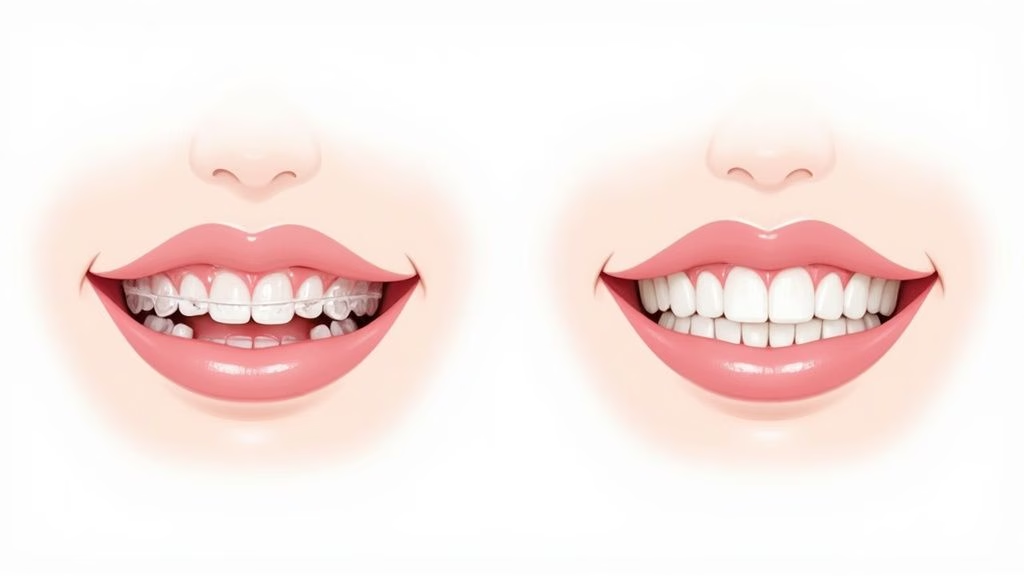
The big question on everyone's mind before starting treatment is always the same: what will my teeth actually look like when this is all over? The aligners before and after change is about more than just a pretty picture; it's the result of tiny, carefully planned movements that add up to a healthier, more confident smile that’s built to last.
Your Guide to an Aligner Smile Transformation
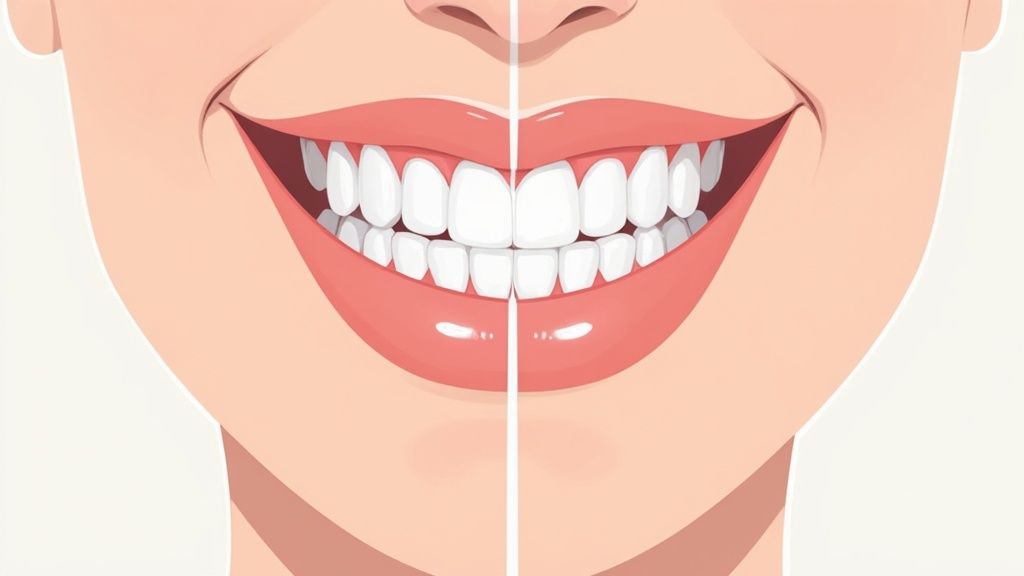
We’ve all seen those incredible before-and-after photos and wondered, "Could that really be me?" The great news is that modern clear aligners are engineered to tackle many of the most common issues, from annoying gaps to crowded and crooked teeth. This whole approach is a world away from the clunky metal braces many of us remember.
Today, straightening your teeth is far more discreet, efficient, and accessible than ever before. It's not just about looks, either—it's about long-term oral health. When your teeth are straight, they're much easier to clean, which helps lower your risk of plaque build-up and gum problems down the road.
What to Realistically Expect from Treatment
Let's be clear: getting your dream smile is a gradual journey, not an overnight miracle. Each set of custom-moulded trays applies just the right amount of gentle pressure to nudge your teeth towards their final destination. While you won't see the full result in a week, most people start noticing small but exciting changes within the first few months. That final "after" photo is the product of sticking to the plan and wearing your aligners consistently.
The whole process really comes down to three key things:
- Precision Planning: It all kicks off with a detailed 3D scan of your mouth. This creates a digital blueprint that maps out every single step of your treatment.
- Gradual Adjustment: Each new aligner you pop in represents one small, calculated step forward. This makes the entire experience both comfortable and completely controlled.
- Professional Oversight: A qualified dentist keeps an eye on your progress from start to finish. This ensures every tooth is moving safely and correctly—a core part of the smarter, more affordable Toothfairy model.
The Rise of Adult Orthodontics in the UK
This move towards more subtle solutions has absolutely supercharged the dental industry. The clear aligners market in the UK is booming, with experts predicting it will rocket to USD 1,368.1 million by 2030. This growth is almost entirely powered by adults, who currently account for about 73.9% of the revenue. They're looking for effective ways to improve their smile without putting their life on hold for traditional braces.
While perfectly straight teeth are the main goal for most, a truly stunning smile sometimes involves looking at the bigger picture. After alignment, some people find that complementary treatments like lip enhancement for a balanced smile can add the finishing touch to their new look.
Seeing is Believing: Real Aligner Case Studies
Technical diagrams and 3D models are one thing, but the real proof is in the pictures. Nothing shows what clear aligners can do better than the real-life transformations of people who’ve been through the process. The journey from a smile you hide to one you love showing off is different for everyone, but the results speak for themselves. These stories aren't just photos; they're the outcome of a carefully planned and professionally guided treatment.
Let's look at some common dental issues and see how a smart, dentist-led aligner system like Toothfairy delivers incredible aligners before and after results. These cases show exactly what's possible when great tech is paired with expert dental supervision.
Case Study 1: Closing the Gaps
Gaps between teeth, or diastema as it's known clinically, are one of the most common reasons people start looking into aligners. Those little spaces can make you think twice before breaking into a big smile.
- The Problem: A patient came to us with noticeable gaps between their upper front teeth. They wanted a discreet fix, and traditional braces were out of the question.
- The Process: We started with a 3D scan, which our dentists used to map out a personalised treatment plan. The aligners were then engineered to gently pull the teeth together, closing the gaps over a period of around 7 months.
- The Outcome: The result? A seamless, perfectly aligned smile with no gaps in sight. The patient’s confidence shot through the roof, and they got there with almost no disruption to their daily life.
Case Study 2: Correcting Overcrowding
Crowded teeth aren't just about appearances. When teeth overlap, they can be tricky to clean properly, creating perfect hiding spots for plaque. Aligners are fantastic for sorting out mild to moderate crowding.
A patient with moderate crowding in their lower teeth was finding it hard to floss properly. They were concerned about their long-term oral health but really didn't want the look and feel of metal braces. The plan we designed for them focused on making space and carefully guiding each tooth into its correct spot.
After 11 months of wearing their aligners diligently, the patient’s lower teeth were beautifully straight. Not only did their smile look amazing, but brushing and flossing became simpler and far more effective. It was a win for aesthetics and for health.
Documenting Your Own Aligner Journey
One of the best parts of the whole experience is watching your own smile change right before your eyes. To really appreciate how far you've come, it's a brilliant idea to take photos along the way. You'll create your own personal "aligners before and after" gallery, which is a huge motivator.
Here’s how to get the best progress shots:
- Find Good Lighting: Natural light is your best friend. Stand facing a window to get bright, even light that doesn't cast shadows on your teeth.
- Be Consistent: Try to take your photos in the same place, at the same time of day, and from the same angles every time you switch to a new set of aligners.
- Get the Right Angles: Make sure you snap photos from the front and both sides. A couple of spoons or even your fingers can work as cheek retractors to get a clear view of your back teeth.
- Keep a Log: Jot down the date and which aligner number you're on with each photo. It helps you track the small, incremental shifts that add up to a big change.
Seeing those gradual improvements week by week makes the whole process feel real and exciting. It stops being a waiting game and turns into a visible journey you're in control of. For many people, that personal photo log is just as powerful as the final "after" shot.
The Smart Technology Behind Your Smile Journey
Those dramatic aligners before and after transformations you see aren't magic. They're the result of incredible precision. Unlike old-school orthodontics, which often relied on frequent, hands-on adjustments, modern clear aligner therapy is built from the ground up using sophisticated digital technology. It’s far less guesswork and much more smart, predictable planning from day one.
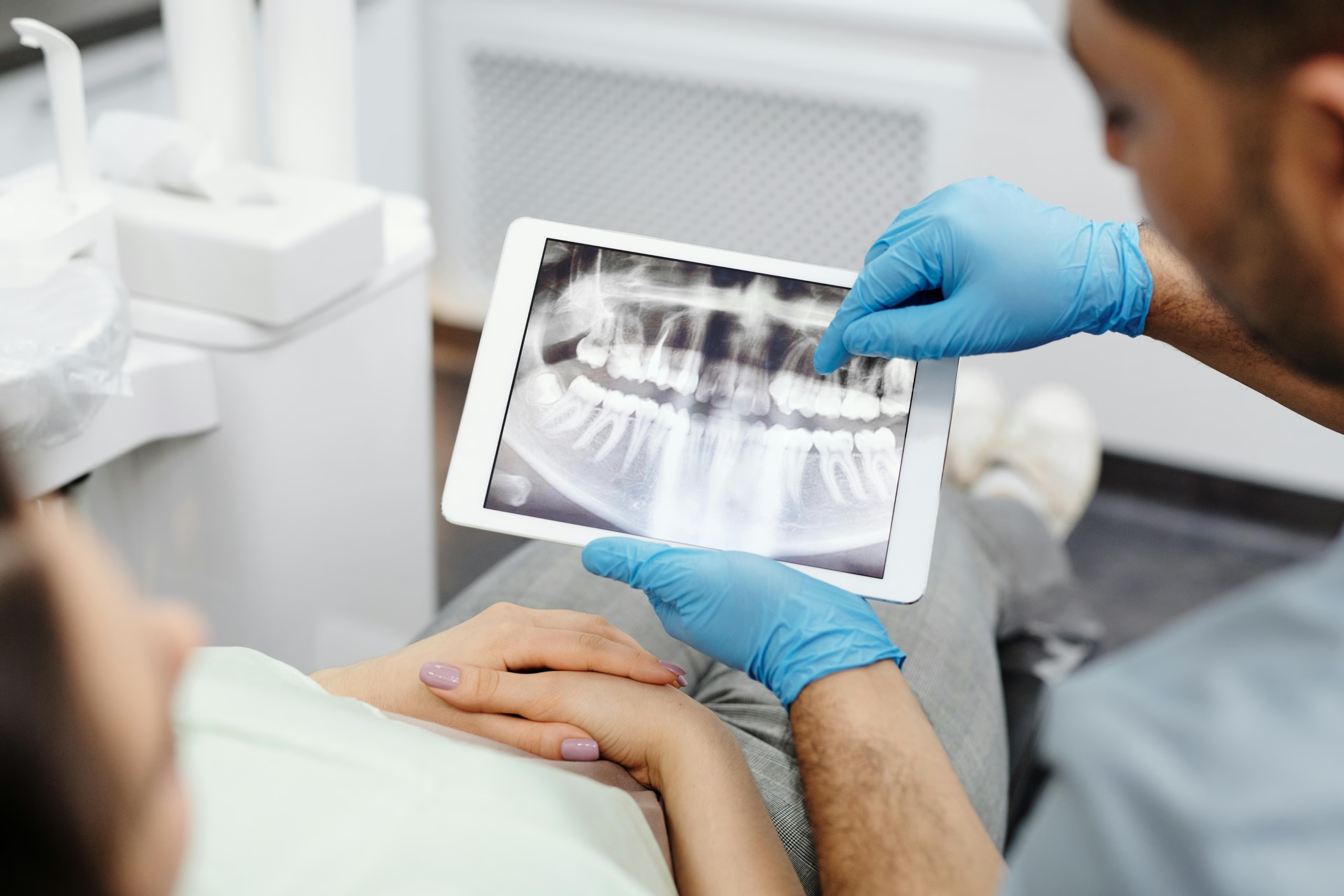
It all kicks off with a highly detailed 3D scan of your mouth. This isn't just a simple picture; it's an incredibly accurate digital replica that maps the exact position of every single tooth. Think of it as creating the perfect "Google Maps" of your current smile, which we then use to plot the most efficient route to your final destination.
From Digital Map to Perfect Smile
Once we have that digital model, specialised software gets to work. It simulates the entire journey your teeth will take, breaking it down into a series of tiny, calculated steps. Each of these steps corresponds to a new set of aligners, and every single tray is engineered to apply gentle, targeted pressure precisely where it's needed.
This digital-first approach means your dentist can see the final result before you even pop in your first aligner. For a modern provider like Toothfairy, this technology is the cornerstone of offering a smarter, more affordable way to straighten teeth. It makes the results predictable and ensures your treatment is optimised for both efficiency and comfort.
This simple visual shows how you can track your own smile’s progress from start to finish.

By documenting the 'Before,' 'Progress,' and 'After' stages, you get a powerful visual diary of your successful smile journey.
The Engine of Modern Orthodontics
This move towards digital precision is exactly what makes today’s aligner treatments so effective. Instead of a one-size-fits-all approach, your treatment plan is designed exclusively for your unique dental anatomy. It’s a huge reason why the results and overall experience can feel so different from one aligner brand to another.
The real advantage of this technology is the control it gives us. Dentists can plan for specific tooth rotations and movements with millimetre-level accuracy—something that simply wasn't possible with older techniques.
This meticulous level of detail means fewer surprises along the way and a much smoother path to your ideal smile. The good news is that the technology is also becoming more accessible. Key breakthroughs, like lower-cost intraoral scanning and the use of AI in treatment planning, are making aligners more affordable. These factors are set to significantly reduce average treatment costs in the coming years, opening up smile transformations to more people. You can discover more insights about the UK clear aligners market and see the technology driving its growth.
The Toothfairy model takes this powerful tech and adds the most important ingredient: human expertise. While the software maps out the journey, a registered UK dentist remotely supervises your progress every step of the way. This oversight ensures the plan is working exactly as it should, giving you the safety and assurance you need for a brilliant, lasting result.
What Really Shapes Your Treatment Timeline
One of the first questions on everyone's mind is, "how long will this actually take?" It's a fair question, but the honest answer is: it really depends. There's no single, one-size-fits-all timeline because every smile is completely unique. The duration of your treatment is a blend of a few key things, from what we're trying to fix to how well you stick to the plan.
Think of it like training for a race. The finish line is your new smile, but how long it takes to get there depends on your starting fitness level and how consistently you follow the training plan. Straightening a slightly crooked tooth is like training for a 5k, whereas correcting a complex bite issue is more like prepping for a marathon. Both are achievable, they just require different time commitments.
The Complexity of Your Case
The biggest factor by far is the complexity of your dental situation. Some alignment issues are straightforward, like closing a small gap between your front teeth. Others are more involved, like untangling crowded teeth or adjusting how your top and bottom teeth meet.
Every tooth's journey is mapped out with precision. If a tooth only needs to shift a tiny bit, that's a quick fix. But if it needs to be rotated or moved a significant distance, that takes more time and a longer series of aligners to do it safely. This is where having a professional's eye is crucial—a dentist makes sure your treatment plan is both effective and realistic for your mouth.
To give you a clearer picture, let's look at some typical timelines for common dental concerns.
Typical Clear Aligner Treatment Timelines
This table breaks down the average treatment duration for different types of alignment issues. Remember, these are just estimates—your personal plan will be tailored to your specific needs after a proper dental assessment.
| Dental Issue | Severity | Typical Treatment Duration |
|---|---|---|
| Minor Gaps or Spacing | Mild | 4-8 months |
| Minor Crowding | Mild | 6-10 months |
| Moderate Crowding | Moderate | 10-15 months |
| Minor Bite Correction | Mild | 12-18 months |
As you can see, a few months can make a huge difference in achieving minor cosmetic tweaks, while more significant changes naturally require a longer, steadier approach to get the best and most stable results.
Your Personal Commitment to the Process
While your dentist creates the roadmap, you're the one in the driver's seat. Clear aligners only work when they're in your mouth, and achieving those amazing aligners before and after results depends on your commitment. The magic number is 20-22 hours every day.
The technology gives us the plan, but your consistency is the engine that makes it all happen. If you regularly miss hours or skip days, your progress will slow down, and you might even need a mid-course correction from your dentist to get back on track.
This is the trade-off you make for the convenience of removable aligners. Unlike traditional fixed braces, the responsibility is entirely on you. Sticking to the schedule is the single best thing you can do to make sure your final result matches the timeline you were given at the start.
Why Professional Oversight Is Non-Negotiable
Trying to straighten your teeth without a dentist overseeing the process is a bit like sailing without a captain. Things can go off course. Everyone's biology is different, and sometimes teeth just don't move as predictably as we'd like. A qualified dentist acts as your guide, making sure everything is progressing safely and effectively.
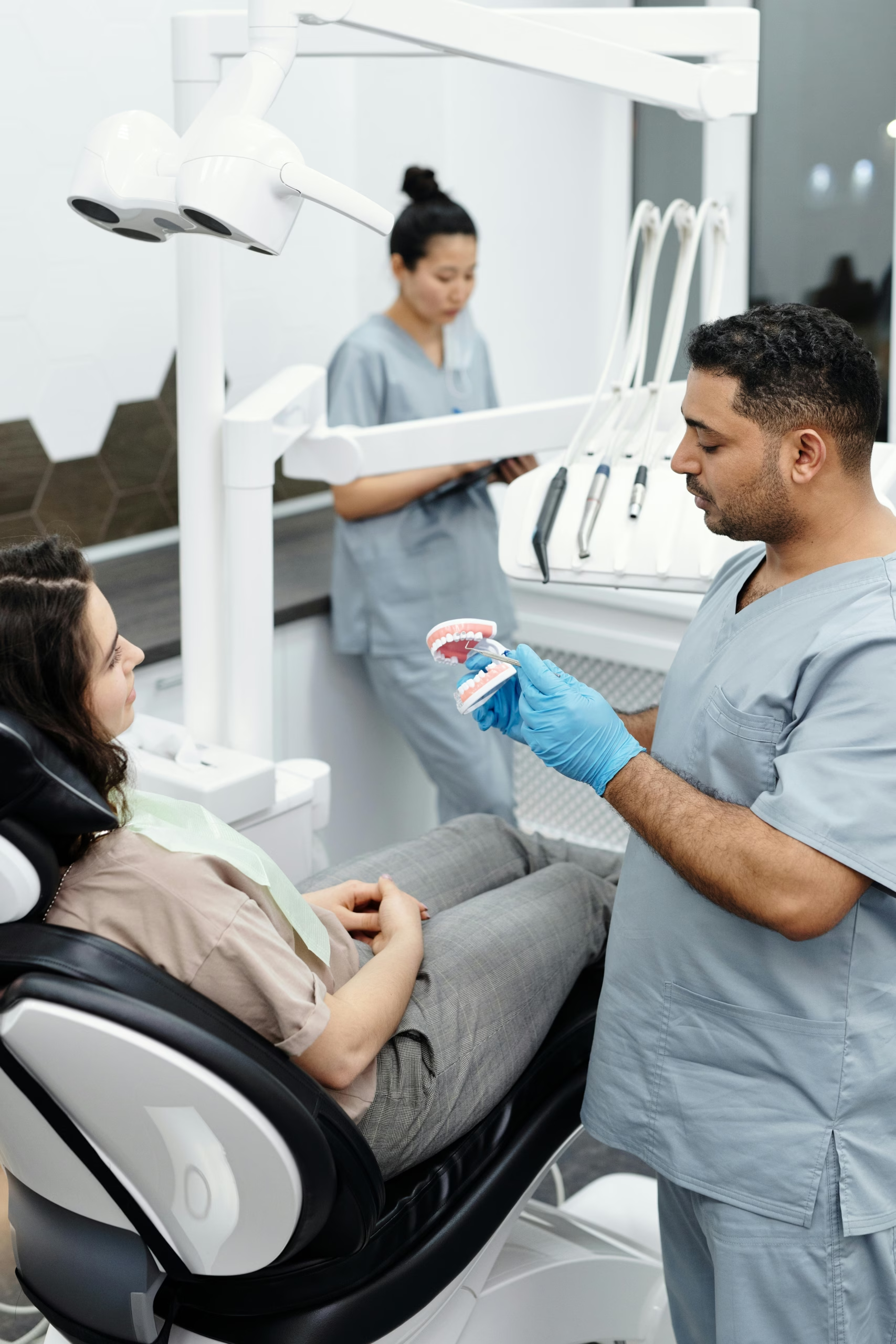
This is fundamental to how we do things at Toothfairy. Our dentists keep a close watch on your journey remotely, checking in to ensure your teeth are tracking with the 3D plan. If a tooth starts being stubborn, they can spot it early and make adjustments. This dentist-led approach gives you the peace of mind you need, ensuring your 'before and after' transformation is not only stunning but also achieved safely and efficiently.
Why Dentist-Guided Treatment Delivers Better Results
When you start looking into clear aligners, it's easy to get lost in the sea of options. So many companies promise a perfect smile, and the focus is often on the aligners themselves. But the single most important part of the journey isn't the plastic trays—it's the professional dental expert guiding you. Trying to straighten your teeth without a qualified dentist is a huge gamble, one that can lead to disappointing aligners before and after photos or, even worse, lasting damage to your oral health.
Think of it this way: your treatment plan is like a detailed flight path. The aligners are the aeroplane, but you absolutely need an experienced pilot—your dentist—to navigate safely. They understand all the complex forces involved in moving teeth, can spot turbulence and correct the course, and make sure you land exactly where you want to be. Flying solo is like taking off without a pilot; you might end up somewhere, but it probably won't be your intended destination, and the journey could get pretty risky.
The Hidden Dangers of DIY Alignment
The idea of a direct-to-your-door kit is certainly tempting, but these options completely skip the crucial oversight needed for a safe and effective treatment. Moving teeth isn't a simple cosmetic fix; it's a complex biological process that needs an expert eye. Without a dentist's input, you're opening yourself up to a whole host of potential problems.
And these aren't just minor hiccups. They can have serious, long-term consequences for both your health and your bank balance.
- Bite Problems: If you shift your teeth without considering how they fit together, you can easily end up with a misaligned bite (malocclusion). This can cause everything from jaw pain and headaches to difficulty chewing properly.
- Root Damage: Applying force too quickly or from the wrong angle can actually damage the roots of your teeth. This is a very serious issue, and unfortunately, it's often irreversible.
- Gum Issues: Aligners that don't fit perfectly can press on your gums, causing them to recede. This not only looks bad but can also increase your risk of gum disease.
- Worse Results Than You Started With: Without a professional making adjustments along the way, you could find your smile looks worse than when you began, meaning you’ll need even more expensive treatment to correct the new problems.
The Toothfairy Model: A Smarter, Hybrid Approach
This is exactly where the Toothfairy model comes in. We’ve found a way to give you the convenience you’re looking for without sacrificing the professional safety you absolutely need. From your very first 3D scan right through to your final retainer, your entire journey is planned and closely monitored by a registered UK dentist. It’s a much smarter and more affordable way to get expert dental care without the hassle of constant trips to a clinic.
Think of your dentist as your personal smile architect. They don't just click 'approve' on a computer-generated plan. They meticulously analyse your unique dental structure, bone density, and overall oral health to build a treatment that is genuinely personalised and safe for you. This expert oversight is simply non-negotiable for achieving a beautiful, healthy result.
This blend of professional expertise and at-home convenience is really changing the game. We're seeing a shift in the market as more people realise the value of a hybrid model that pairs dentist-led care with modern technology, leading to much higher success rates.
With Toothfairy, you truly get the best of both worlds. A real dentist checks in on your progress remotely and can step in immediately if a tooth isn't tracking as expected. This proactive care ensures your aligners before and after story is one you’ll be proud to show off—a story of confidence, success, and lasting health.
Keeping Your New Smile Perfect for Life
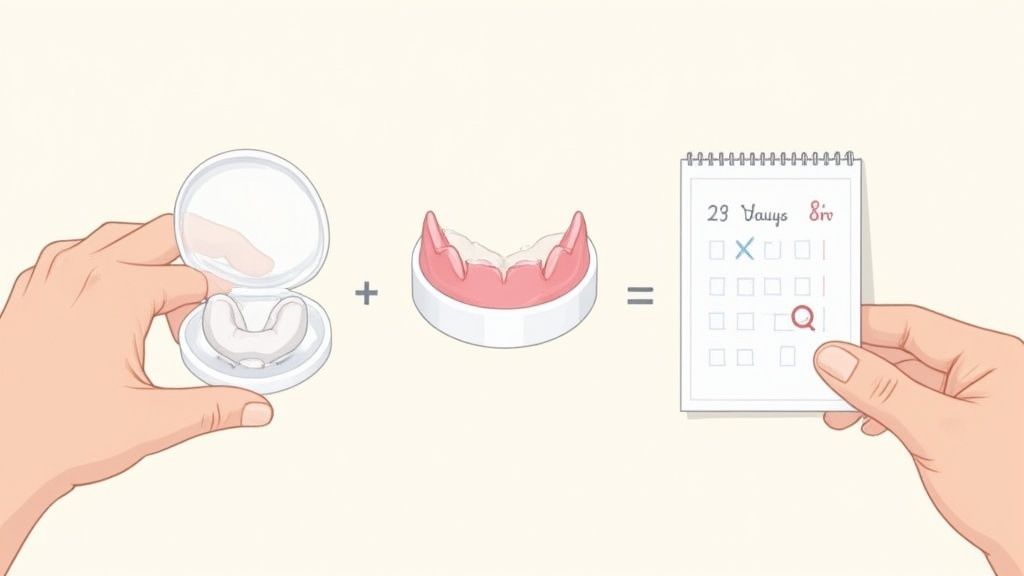
Finishing that last aligner tray feels amazing, but your journey isn’t quite finished. In fact, the most important part of locking in your fantastic aligners before and after results is just getting started. It's called the retention phase, and it's your secret weapon for making sure that new smile lasts a lifetime.
Believe it or not, your teeth have a memory. The ligaments and bone tissue that anchor them have just gone through a major remodel. Left to their own devices, they have a natural tendency to drift back to their old, familiar positions. This is a totally normal process called orthodontic relapse, but the good news is, it's also completely preventable with the right follow-up care.
Your retainer is basically an insurance policy for your teeth. Think of it this way: your aligners did the hard work of moving everything into place, and now your retainer's job is to hold it all there. It's the one non-negotiable step to protect your investment and keep your smile just as straight as it was on the day you finished treatment.
Understanding Your Retainer Options
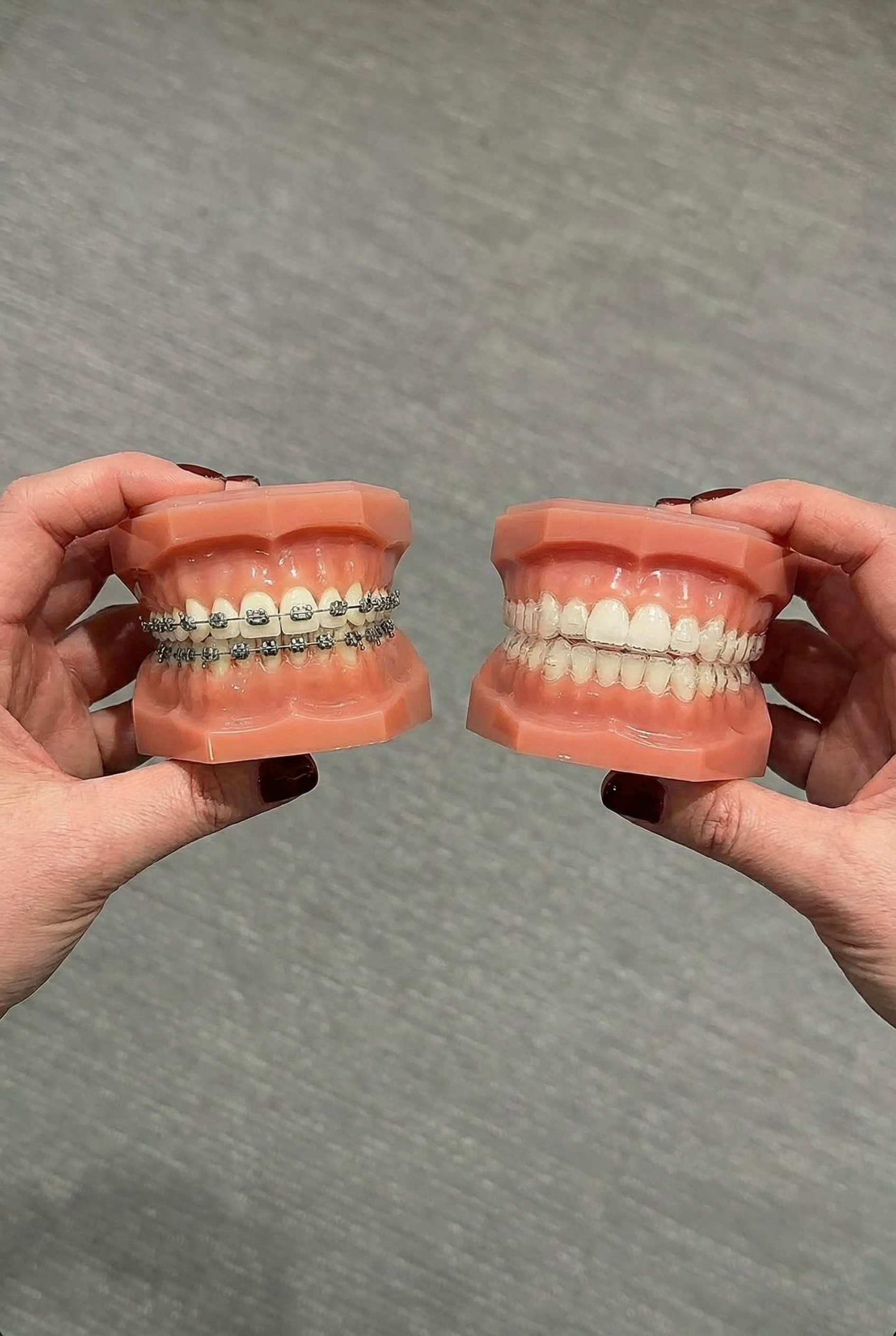
Once your alignment is complete, your dentist will get you set up with a retainer. There are a couple of different kinds out there, but they all do the same job: stop your teeth from moving. The two you’ll most likely come across are clear retainers and fixed (or bonded) retainers.
- Clear Retainers: These will feel very familiar, as they look and feel almost identical to your aligners. They're custom-moulded from a tough, clear plastic that fits perfectly over your teeth, and because you can take them out, they're dead easy to clean.
- Fixed Retainers: This is a very thin, discreet wire that gets permanently bonded to the back of your front teeth. You can't see it from the front, and it provides round-the-clock protection without you ever having to remember to put it in.
Your dentist will advise on the best option for you, based on your unique case and how your teeth were moved. Sometimes, a combination of both offers the ultimate peace of mind.
Creating a Lifelong Retention Habit
To begin with, you'll probably wear your removable retainer full-time, just like your aligners. But after a few months, once things have settled, your dentist will likely give you the go-ahead to switch to nights-only wear. It quickly becomes a simple, effortless part of your bedtime routine that protects your smile while you sleep.
A retainer’s job is to hold the new position of your teeth until your bones and gums fully adapt and stabilise. Skipping this step is the number one reason for orthodontic relapse, undoing all the progress you've made.
Looking after your retainer is simple, too. A quick daily clean with a soft brush and lukewarm water is all it takes to keep it fresh. With a tiny bit of care, that retainer will be the guardian of your smile, making sure your 'after' photo is your reality, forever. This small commitment is the final piece of the puzzle to your successful smile story.
Got Questions About Your Aligner Journey? We’ve Got Answers
Seeing those amazing aligners before and after photos is exciting, but it’s completely normal to still have questions. Deciding to straighten your smile is a big step, and getting into the nitty-gritty details is what builds real confidence.
So, let's tackle the questions that are probably on your mind. Getting clear, honest answers helps you know what to expect and feel ready to begin.
How Soon Before I Actually See a Difference?
While the grand finale takes a bit of time, most people start to spot the first subtle changes within 6 to 8 weeks. It might be a single tooth looking a little less crowded, or a tiny gap starting to shrink. Those small, early wins are incredibly motivating!
Of course, the most striking results come at the very end of your treatment. That said, I always recommend taking weekly progress photos. It's a fantastic way to see the gradual improvements and really appreciate how much your smile is changing along the way.
Is Getting My Teeth Straightened Painful?
Honestly, you can expect some pressure or mild tenderness for a day or two each time you switch to a new set of aligners. Think of it as a good sign – it means your aligners are actively and correctly guiding your teeth into their new positions.
Most people describe it as more of a dull ache than a sharp pain, and it’s very manageable. When you compare it to the stories you hear about traditional fixed braces, the general consensus is that clear aligners offer a much more comfortable experience overall.
Can Aligners Tackle Really Big Dental Problems?
Clear aligners are brilliant for sorting out a whole host of common issues, from crowding and gaps to minor bite problems. For most adults wanting to improve their smile, they're an incredibly effective tool.
However, for some very severe jaw issues or highly complex orthodontic cases, a different treatment might be needed. The only way to know for certain is to get a professional to take a proper look. At Toothfairy, our qualified dentists carefully analyse your scans to confirm that our aligner system is the right—and safest—way to get you that fantastic 'after' you’re looking for.
This professional assessment isn't just a box-ticking exercise; it's essential. It ensures your treatment plan is designed for your unique dental structure, protecting your oral health for the long run.
What Happens if My Teeth Aren’t Following the 3D Plan?
This is exactly why having a dentist oversee your treatment is so important. Every now and then, a tooth can be a little stubborn and not move quite as the 3D simulation predicted. It’s a normal thing that can happen in orthodontics.
If your progress starts to drift from the plan, your supervising dentist can step in right away. They might suggest what’s called a "refinement," where you get a new scan and a few extra aligners to nudge things back on track. This expert oversight is a core part of the Toothfairy process, acting as a safety net to make sure you get the brilliant final result you signed up for.
Ready to start your own "before and after" story? Toothfairy offers a smarter, dentist-guided path to the confident smile you've always wanted. Start your journey with a free online consultation today!
Last updated on December 19, 2025

Dr. Deepak
ToothFairy Care Team.
Dr. Deepak
ToothFairy Care Team.