What Causes Jaw Pain and How to Find Lasting Relief
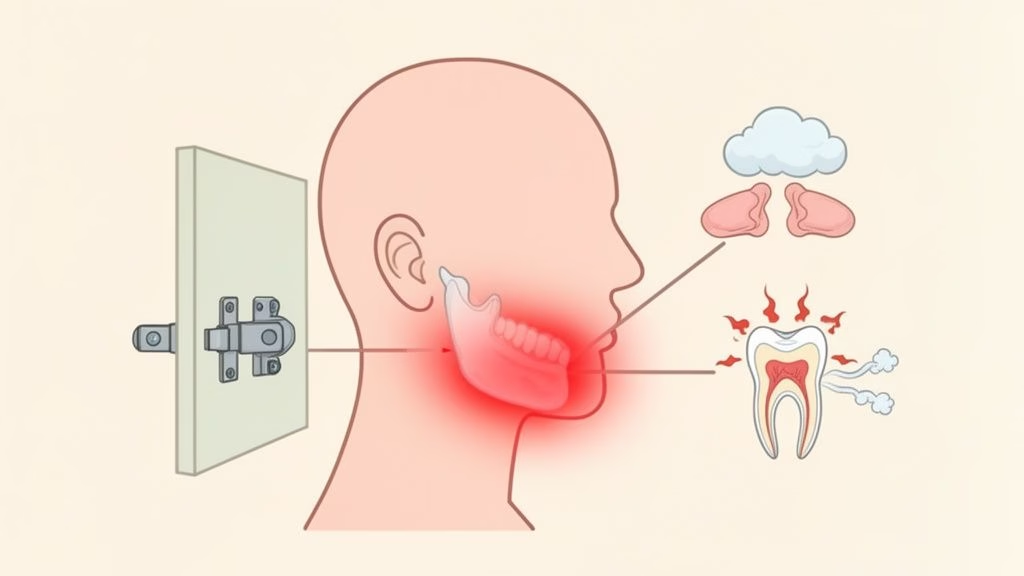
Jaw pain is rarely a problem in and of itself. Think of it more as a signal flare from your body, letting you know something else is going on. The source of that ache can usually be traced back to one of three areas: trouble with your teeth, issues with the jaw joint and its muscles, or even pain that's actually starting somewhere else entirely, like your sinuses.
Figuring out which one is causing your discomfort is the first real step toward getting some relief.
A Quick Guide to Understanding Your Jaw Pain
That dull, persistent ache or sudden, sharp pain in your jaw can really throw a spanner in the works. It turns everyday things like chatting, eating your favourite meal, or even just yawning into a painful experience. More often than not, the culprit is the temporomandibular joint, or TMJ for short.
Imagine a complex sliding hinge that connects your jaw to your skull, with one on each side of your face – that’s your TMJ. It’s an incredible piece of natural engineering, responsible for all the up-and-down and side-to-side movements your jaw makes. When everything is working smoothly, you don’t even know it’s there. But if the moving parts—the bones, muscles, and the little shock-absorbing disc inside—get out of alignment, you’ve got a problem. This is what dentists call a Temporomandibular Disorder (TMD).
The Primary Sources of Discomfort
While TMD is a big player, it's certainly not the only cause of jaw pain. To get a clearer picture, it helps to group the potential issues into a few key categories.
- Dental Problems: A lot of jaw pain actually starts inside your mouth. An infected tooth (known as an abscess), wisdom teeth that are stuck or coming in at an angle, advanced gum disease, or even deep cavities can all send pain signals radiating out into your jaw.
- Musculoskeletal Strain: Just like the joints in your knees or elbows, the TMJ can take a beating. Constantly clenching or grinding your teeth (a condition called bruxism), arthritis settling into the joint, or a direct injury from a knock or fall can all cause inflammation and serious discomfort.
- Referred Pain: Here’s a tricky one: sometimes the pain you feel in your jaw isn't coming from your jaw at all. The pressure from a sinus infection (sinusitis) can feel like it's in your upper jaw, while tension headaches and stubborn ear infections can also make your jaw feel incredibly sore.
Jaw pain is your body's way of telling you something is wrong. It might be a simple dental fix or a more complex joint issue, but leaving it unchecked often leads to bigger problems and chronic pain down the line.
To give you a quick overview, here’s a simple breakdown of the most common triggers for jaw pain and what they typically feel like.
Common Jaw Pain Triggers at a Glance
| Cause Category | Common Examples | Typical Symptoms |
|---|---|---|
| Dental Issues | Tooth abscess, impacted wisdom teeth, severe gum disease, cavities | Sharp, throbbing pain that can be localised to one tooth but radiates into the jaw; sensitivity to hot or cold; swelling in the gums or cheek. |
| Musculoskeletal | Teeth grinding (bruxism), arthritis, jaw injury, TMD | Dull, aching pain around the ear and jaw joint; clicking or popping sounds when opening the mouth; limited jaw movement or locking; headaches. |
| Referred Pain | Sinusitis, ear infections, tension headaches | A feeling of pressure or a dull ache in the upper jaw and cheeks; pain that often comes with other symptoms like a blocked nose, earache, or headache. |
This table can help you start connecting the dots between your symptoms and a potential cause, but a proper diagnosis is always the next step.
Navigating Your Next Steps
Trying to pinpoint the exact cause on your own can be tough, but you don't have to. The great news is that getting a professional opinion is much easier than it used to be, without the hassle of long waiting lists or trying to fit an appointment into a busy schedule.
Services like Toothfairy are changing the game. You can have a virtual consultation with a fully qualified UK dentist from the comfort of your own home. It’s a brilliant first port of call, allowing a professional to listen to your symptoms, assess the situation, and point you in the right direction for diagnosis and treatment. Whether it feels like a dental emergency or it's a nagging ache you've had for weeks, getting that timely advice is key to finding lasting relief.
Unpacking the Most Common Causes of Jaw Pain
Trying to figure out what's causing your jaw pain can feel like a bit of detective work. Is it your teeth? The joint itself? Something else entirely? While the reasons can vary, most jaw pain traces back to a few key culprits. Let's dig into the most common sources of that nagging ache.
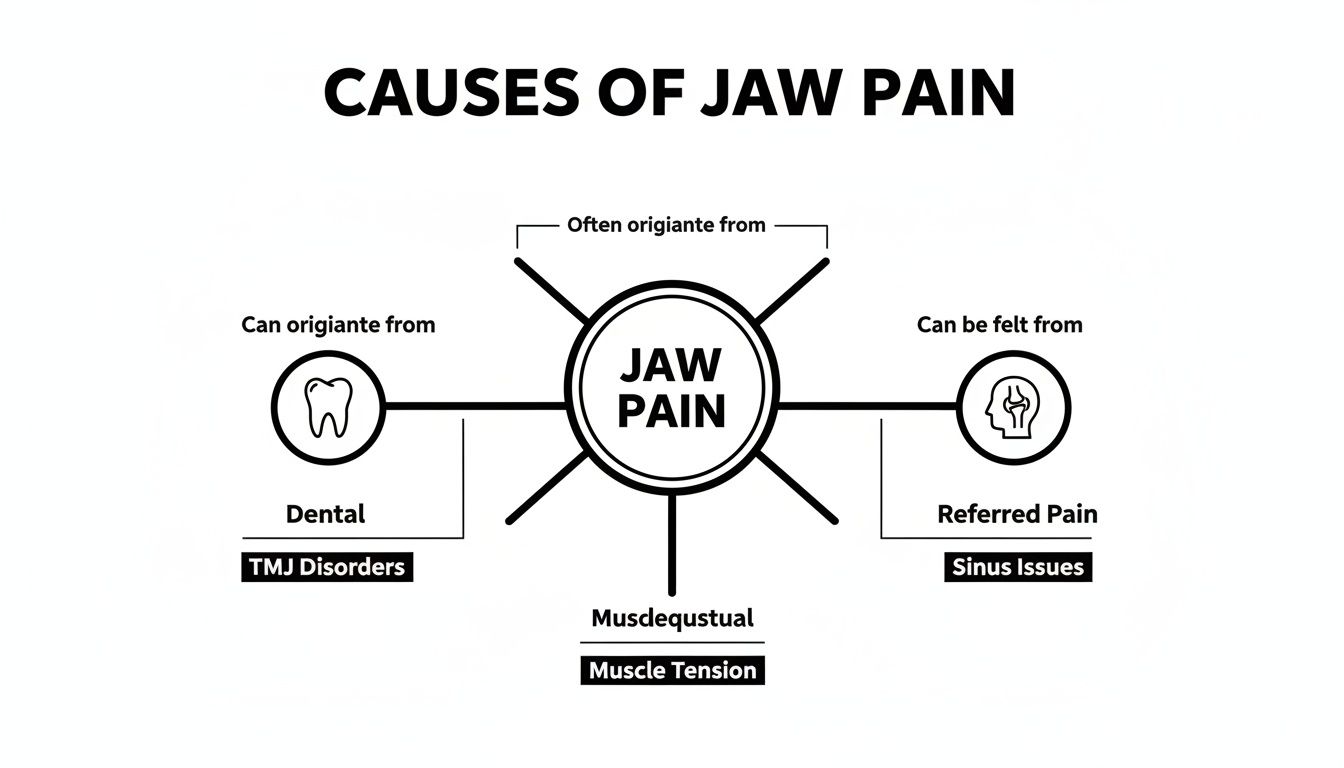
This diagram helps visualise how everything is connected, showing that dental problems, muscle issues, and even pain referred from elsewhere can all end up feeling like jaw pain.
When the Jaw's Hinge Goes Wrong: Temporomandibular Disorders
One of the biggest players in the world of jaw pain is a group of conditions known as Temporomandibular Disorders (TMD). It helps to think of your jaw joint—the temporomandibular joint, or TMJ—as a simple door hinge. When it's working properly, it glides open and shut smoothly, without a sound.
But what happens if that hinge gets rusty, knocked out of alignment, or put under too much strain? The door might start to creak, stick, or even get jammed. That's essentially what's happening with TMD. The small, shock-absorbing disc inside your jaw joint can slip out of place, or the muscles around it can get tired and inflamed.
This kind of misalignment is what leads to those classic tell-tale symptoms:
- A distinct clicking, popping, or grating noise when you open your mouth.
- Your jaw feeling like it’s “locking up” or getting stuck.
- An ache that feels like it’s in your ear, but there's no infection.
- Pain and difficulty when you're trying to chew.
And it's not a rare problem. TMD is a primary cause of jaw pain in the UK, affecting up to 1 in 15 people—that's roughly 4.5 million adults. It’s most common in people aged 20-40 and, if left untreated, the discomfort from eating and the limited movement can become a persistent issue.
When Your Teeth Are the Real Culprits
Sometimes, the pain you feel in your jaw has nothing to do with the joint itself. Instead, the problem starts in your mouth. Dental issues are notorious for sending pain signals shooting through the jaw, easily tricking you into thinking the source of the problem is somewhere else.
A deep tooth abscess, which is a nasty pocket of pus caused by a bacterial infection, can create an intense, throbbing pain that radiates right into the jawbone. In the same way, an impacted wisdom tooth trying to force its way through can create immense pressure and discomfort across your entire jaw.
Another major dental cause is malocclusion—the technical term for a "bad bite." When your top and bottom teeth don't line up correctly, your jaw muscles have to work overtime just to chew properly. This puts unnatural stress on the muscles and the TMJ, day in and day out. Over time, that constant strain can lead directly to chronic jaw pain.
The Tangled Web of Facial Pain
Your head and neck are a complex network of muscles, nerves, bones, and tissues. Because everything is so interconnected, a problem in one spot can easily trigger pain somewhere else entirely. This is why getting to the bottom of jaw pain requires looking at the bigger picture.
It often surprises people to learn their jaw pain isn't actually coming from their jaw. It could be a symptom of sinus pressure, muscle tension, or even a condition like arthritis.
Think about these other related causes:
- Bruxism (Teeth Grinding): Many of us grind or clench our teeth without even realising it, especially when we're stressed or sleeping. This habit puts a huge amount of force on the jaw muscles and TMJ, often leading to a sore jaw and headaches first thing in the morning.
- Stress and Tension: Emotional stress makes us tense up, and the jaw and neck muscles are often the first to feel it. When looking into jaw pain, it's worth considering how nearby areas can contribute, including issues like neck knots and their causes.
- Arthritis: Just like the joints in your knees or hands, the TMJ can be affected by osteoarthritis or rheumatoid arthritis. This can cause inflammation, stiffness, and persistent pain in the jaw.
- Sinus Problems: When your sinuses get inflamed (a condition called sinusitis), the pressure can build up right behind your cheekbones. This often creates a dull, constant ache in the upper jaw that feels very much like a toothache.
How Dentists Pinpoint the Source of Your Pain
Knowing what to expect when you get your jaw pain checked out can make the whole thing feel a lot less daunting. When your jaw hurts, a dentist’s first job is to become a bit of a detective, piecing together clues to figure out what’s really going on. Whether you're in a clinic or talking to a professional online, the investigation always starts with a good old-fashioned chat.
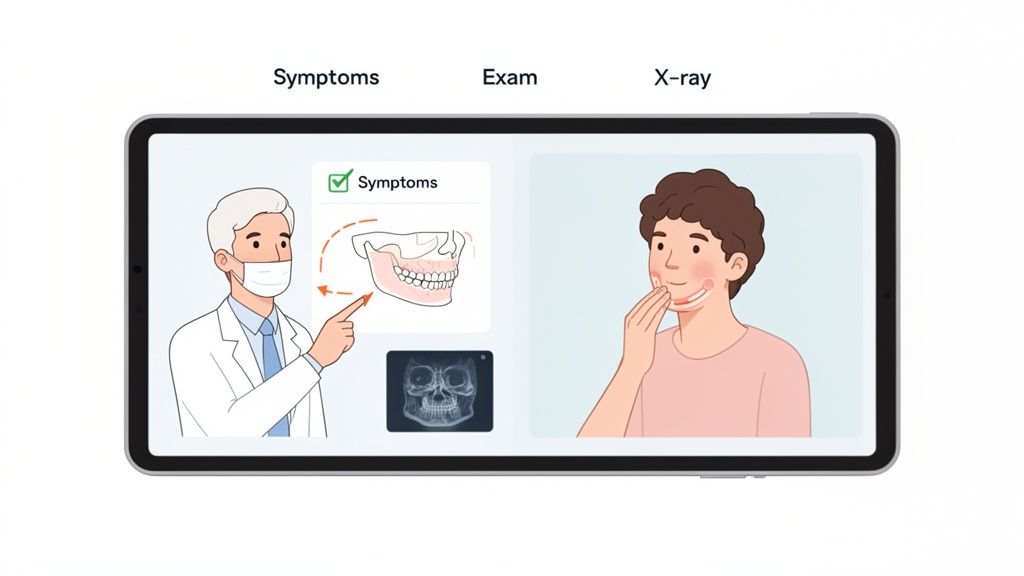
This initial conversation is absolutely vital. Your dentist needs to understand the story of your pain: where exactly it is, what it feels like (is it a sharp stab, a dull ache, or a throbbing pulse?), and what seems to trigger it or make it feel better. They’ll also ask when it all started and if you’ve noticed any other odd symptoms tagging along, like headaches or earaches.
The Hands-On Examination
After listening to your story, the next step is a physical examination to narrow down the suspects. This is where the dentist gets hands-on to check the mechanics of your jaw and the muscles around it. Think of it like a mechanic listening to a car engine for strange noises or checking for worn parts.
During this part of the assessment, your dentist will usually:
- Check Your Range of Motion: They’ll ask you to open and close your mouth slowly, and then move your jaw from side to side. This simple test shows them if your movement is restricted or lopsided.
- Feel for Tender Spots: By gently pressing on the muscles around your jaw, cheeks, and neck, the dentist can pinpoint specific areas of inflammation or muscle tightness.
- Listen for Joint Noises: Using a stethoscope or just their own ears, they will listen for any clicking, popping, or grating sounds your jaw makes. These noises are often a dead giveaway for problems within the temporomandibular joint (TMJ).
This physical check provides crucial clues about whether the problem is coming from the joint itself, the muscles, or a bit of both.
Looking Deeper with Diagnostic Imaging
Sometimes, a chat and a physical exam don't tell the whole story. When your dentist needs to see what’s happening beneath the surface, they'll turn to diagnostic imaging. These tools give them a clear picture of the bones, teeth, and other structures that are hidden from view.
The two most common types of imaging used for jaw pain are:
- Dental X-rays: These are brilliant for spotting any issues related to your teeth and the surrounding bone. An X-ray can instantly reveal things like a hidden tooth abscess, an impacted wisdom tooth, or bone loss from severe gum disease.
- CT Scans: A Cone Beam Computed Tomography (CBCT) scan creates a highly detailed, three-dimensional image of your jaw. This advanced scan is especially useful for getting a crystal-clear look at the TMJ’s bone structure, helping to diagnose conditions like arthritis or damage from an old injury.
A thorough diagnosis is the foundation of effective treatment. By combining your story, a physical exam, and imaging, your dentist can move beyond just treating symptoms and get right to the source of your pain.
The Power of a Virtual First Step
In many cases, you don’t actually need to rush to a clinic to get the ball rolling. This is where modern dental care offers a smarter, more convenient way forward. With a service like Toothfairy, you can have a video consultation with a qualified UK dentist right from your own home.
During this virtual assessment, the dentist can perform a surprisingly effective initial evaluation. They’ll guide you through a self-examination, asking you to point to where it hurts, check your own range of motion, and describe your symptoms in real-time. This gives them enough information to make an informed judgement on the likely cause and advise you on the best next steps.
For many people, this means getting immediate, practical advice on home care to manage the pain. For others, it might mean a referral for an in-person X-ray. Crucially, it helps you understand how serious your situation is and can save you from an unnecessary and stressful trip to A&E, putting you on a clear and direct path to relief.
Finding Immediate Jaw Pain Relief at Home
When that familiar, nagging ache starts in your jaw, the first thing on your mind is getting it to stop. The good news is that while you're figuring out your next steps or waiting for an appointment, there are some really effective 'first-aid' tricks you can use at home to get things under control.
These tips are all about giving your sore jaw a much-needed rest and calming down irritated muscles and joints.
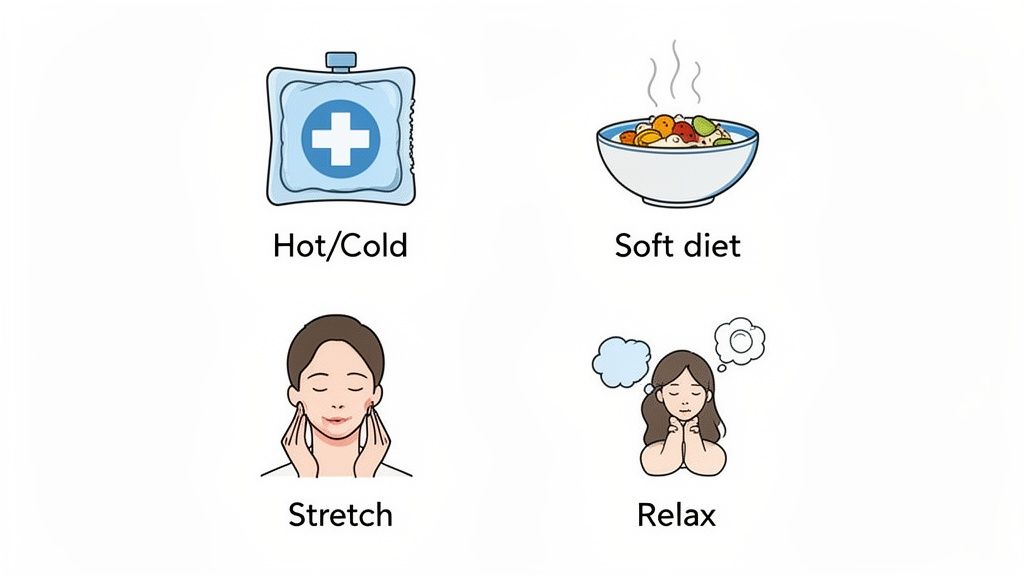
Think about it like a sprained ankle – you wouldn’t carry on running a marathon. The same principle applies here. The main goal is to rest the joint, and you’d be surprised how much difference that can make to your pain levels.
Gentle Therapies to Ease Discomfort
One of the easiest and most powerful things you can do is play with temperature. Switching between hot and cold packs can bring surprisingly quick relief right where you need it.
- Cold Packs: If the pain is from a recent injury or there’s swelling, grab a cold pack (or some ice wrapped in a tea towel). Hold it on the sore spot for about 10-15 minutes. The cold helps to numb the area and reduce inflammation.
- Warm Compresses: For pain that feels more like tight, overworked muscles, a warm, moist flannel or a heat pad is your best friend. Apply it for 15-20 minutes. The warmth encourages tight muscles to relax and boosts blood flow, easing that stiff feeling.
Another game-changer is temporarily switching to a soft-food diet. Things like crusty bread, steak, or even crunchy apples make your jaw work overtime. Give it a holiday by sticking to things like soup, smoothies, yoghurt, and mashed potatoes. This simple change allows your jaw muscles to properly rest and recover.
These home-care strategies are powerful tools for managing immediate symptoms, but they don't address the root cause. Consider them a bridge to professional care, not a replacement for it.
Active Steps for Pain Management
Resting is key, but you can also take a more active role in your recovery.
Gentle stretching can work wonders for releasing built-up tension and improving how far you can comfortably open your mouth. A great starting point is to slowly open your mouth as wide as feels comfortable without pain, hold it for a few seconds, and then slowly close it again. Don’t force it.
It's also worth remembering that stress is a huge trigger for jaw pain. Many of us clench or grind our teeth without even realising it when we're stressed. Simple things like deep breathing exercises, meditation, or even just a brisk walk can lower your stress levels and, in turn, help your jaw muscles to unclench. For short-term relief, over-the-counter pain relievers like ibuprofen can also help, but always follow the directions on the packet.
Of course, trying to manage symptoms on your own can be a bit nerve-wracking. If you're not sure you're doing the right thing or feel your pain is getting worse, getting a professional opinion is crucial. The Toothfairy app is a fantastic resource here. You can jump on a video call with a real dentist—day or night—to get reassurance, check if your self-care is on track, and figure out if you need more urgent help. It offers genuine peace of mind when you need it most.
Professional Treatments for Long-Term Jaw Health
Once your dentist gets to the bottom of what's causing your jaw pain, the path to feeling better becomes much clearer. We're now moving beyond the quick fixes you can do at home and into professional treatments that tackle the root cause, not just the ache. The right approach for you is completely personal and depends entirely on your diagnosis.
For a lot of people, the answer is surprisingly straightforward and starts with a dental issue. If an X-ray shows a deep cavity or an abscess is the hidden culprit, treatments like a filling or root canal therapy can be a massive relief. These procedures get rid of the infection, which in turn stops the referred pain that was making your jaw throb.
Custom Solutions for Joint and Muscle Strain
But what if the problem is with the jaw joint itself—the temporomandibular joint (TMJ)—or the muscles around it? This is common for anyone dealing with Temporomandibular Disorders (TMD) or bruxism (that's the technical term for teeth grinding).
In these cases, one of the most effective tools we have is a custom-made oral appliance, like a splint or a mouthguard. These aren't the generic, boil-and-bite guards you find at the chemist; they're meticulously crafted to fit the unique landscape of your mouth.
- Occlusal Splints: Think of these as a hard acrylic device that clips over your upper or lower teeth. They're designed to create a tiny bit of space that encourages your overworked jaw muscles to finally relax. They also gently guide your jaw into a more comfortable position, easing pressure on the joint.
- Mouthguards: If you're a nighttime grinder, a custom guard is your best friend. It acts as a protective cushion between your top and bottom teeth, absorbing the immense force of clenching and grinding. This can make a world of difference to that morning jaw soreness and the headaches that often come with it.
To help you understand the options, here's a quick comparison of the common professional treatments available.
Comparing Jaw Pain Treatment Options
| Treatment | Best For | How It Works | Toothfairy's Role |
|---|---|---|---|
| Custom Mouthguard/Splint | Teeth grinding (bruxism) and TMD. | Creates a protective barrier between teeth, repositions the jaw slightly to relax muscles and reduce strain on the TMJ. | Can conduct a virtual consultation to diagnose bruxism and arrange for an at-home impression kit for a custom-fit night guard. |
| Dental Work (Fillings, etc.) | Pain referred from a specific tooth due to decay, infection, or an abscess. | A dentist treats the underlying dental problem (e.g., removes decay, performs a root canal), which eliminates the source of the pain. | Can diagnose dental issues through a video consultation and refer you to a partner clinic for necessary in-person treatment. |
| Orthodontics (Clear Aligners) | Jaw pain caused by a misaligned bite (malocclusion) that puts stress on the jaw joint and muscles. | Gently and gradually moves teeth into their correct positions, allowing the jaw to sit and function without strain. | Offers an affordable and convenient way to correct malocclusion with Toothfairy’s clear aligners, supervised by UK dentists via the app. |
| Physiotherapy | Muscle-related jaw pain, limited movement, or post-injury recovery. | Uses targeted exercises and manual therapy to strengthen jaw muscles, improve flexibility, and restore a normal range of motion. | Can recommend and work alongside a physiotherapist as part of a holistic treatment plan. |
Choosing the right path depends on an accurate diagnosis, which is why a professional consultation is always the first step.
Correcting the Bite for Lasting Stability
Sometimes, the problem is a ‘bad bite,’ or what we call malocclusion. When your teeth don't line up correctly, it puts constant, uneven stress on your jaw. In these situations, just managing the symptoms won't provide a lasting solution. Fixing the alignment itself can be a total game-changer, allowing your jaw to work the way it was naturally meant to.
This is where modern solutions like Toothfairy’s clear aligners offer a much smarter route to relief. They provide a convenient and highly effective way to treat jaw pain stemming from malocclusion. The whole process is supervised from start to finish by qualified UK dentists through the Toothfairy app, as your teeth are gently guided into their ideal positions.
By correcting your bite, you're not just straightening your smile; you're fundamentally improving your jaw's mechanics. This can resolve chronic pain by eliminating the daily muscular strain that was causing it in the first place, offering a permanent solution rather than a temporary fix.
Unlike some specific aligner brands that can be expensive and demand lots of in-person appointments, Toothfairy makes expert-led cosmetic dentistry more accessible. Because the process is managed virtually, it fits into your life without hassle, all while ensuring your journey to a pain-free jaw is professionally guided.
A Team Approach to Jaw Health
Finally, it’s worth remembering that treating jaw pain isn’t always just about your teeth. A truly comprehensive plan often brings in other healthcare professionals to work together for your relief.
Your dentist might suggest physiotherapy to help you strengthen your jaw muscles and improve your range of motion with specific exercises. If you're dealing with severe inflammation or muscle spasms, they might prescribe medication like muscle relaxants for short-term relief. By combining these different angles, your treatment plan becomes a powerful, well-rounded strategy for getting you comfortable—and keeping you that way.
Keeping Jaw Pain from Coming Back
The old saying "prevention is better than a cure" is spot on when it comes to jaw pain. The best way to deal with that familiar ache is to stop it from starting in the first place. By adopting a few smart habits, you can make a real difference in keeping your jaw healthy and comfortable, steering clear of future flare-ups. It’s all about reducing strain and catching small issues before they snowball.
One of the most powerful strategies is simply paying more attention to your daily habits. Take your posture, for example. It plays a surprisingly big role. Slouching over a desk all day forces your neck and jaw into an awkward position, leading to muscle tension that can easily travel up into your jaw. Just sitting up straight can help keep everything properly aligned.
Building Jaw-Friendly Habits
Beyond posture, little adjustments throughout your day can significantly reduce the wear and tear on your jaw joints and muscles. It doesn't have to be a massive overhaul.
- Mind What You Eat: Try to steer clear of excessively hard, chewy, or sticky foods. Things like tough steaks, hard-boiled sweets, and chewing gum force your jaw to work overtime, putting a lot of repetitive stress on those delicate joints.
- Keep Stress in Check: Stress is a huge culprit behind jaw pain, often causing us to clench our teeth without even realising it. Finding what works for you—whether it's deep breathing exercises, meditation, or a bit of regular exercise—can help your jaw muscles finally relax.
- Stick to Good Oral Hygiene: This is fundamental. Keeping your teeth and gums in top shape by brushing twice a day and flossing daily helps prevent problems like cavities and gum disease, which are very common sources of referred jaw pain.
Prevention isn't just about dodging bad habits. It's about creating a system of care that supports your long-term oral health. Regular check-ups are a critical part of that system, acting as an early warning for potential problems.
The Role of Consistent Professional Care
Regular dental check-ups are your first line of defence. A dentist can spot the early signs of trouble, like tooth wear from grinding or the beginnings of a misaligned bite, long before you might notice them yourself. But we all know that fitting these appointments into a packed schedule can be tricky and expensive.
This is where a service like Toothfairy can be a game-changer, making ongoing care far more accessible and affordable. Our platform makes it simple to have regular check-ins with qualified UK dentists right from your own home, helping you stay on top of your oral health without the usual hassle.
For businesses, this model is a great way to proactively support employee wellness by providing dental care that can reduce downtime from painful issues. By making professional oversight convenient, you can catch and address what causes jaw pain long before it gets serious.
Your Jaw Pain Questions, Answered
We’ve covered a lot of ground on what causes jaw pain and how to treat it. Still, you probably have a few specific questions buzzing around. Let's tackle some of the most common ones I hear from patients.
Is My Jaw Pain a Dental Emergency?
It's a fair question. Most of the time, jaw pain isn't a drop-everything-and-run situation and can be managed until you can get a regular appointment. But there are a few serious red flags you should never ignore.
If you're dealing with severe, relentless pain that over-the-counter painkillers can't even touch, that's a sign to get help immediately. The same goes for any major swelling that starts to make breathing or swallowing difficult, a high fever along with the pain, or if the pain started right after a knock to the face or head. These could signal a dangerous infection or even a fracture, which needs urgent care.
Not sure if it's a true emergency? Don't just sit there worrying. You can get a quick verdict with Toothfairy’s 24/7 emergency video consultations. A qualified UK dentist can assess your situation and tell you exactly what you need to do next.
Can Teeth Straightening Aligners Make Jaw Pain Worse?
This is a really common concern, and it makes sense to ask. When you first start with aligners, a bit of minor discomfort is normal as your teeth start moving. However, if the treatment is done right, it should actually get rid of jaw pain caused by a bad bite, not create it.
The secret is professional supervision. A dentist needs to be in the driver's seat, making sure your treatment plan is safe and correctly fixing the alignment issues that are stressing your jaw in the first place. It’s a very different story from unsupervised, direct-to-consumer options that don't have that crucial clinical oversight. If you're looking for a smarter, more affordable alternative to some big-name brands, Toothfairy’s dentist-supervised clear aligners offer a safe and effective way to a healthier bite and a happier jaw.
What’s the Link Between Stress and Jaw Pain?
The connection is incredibly direct and surprisingly strong. When you're stressed out, your body's "fight or flight" mode kicks in, causing muscles all over your body to tighten up. For many people, the powerful muscles in the jaw are the first to clench.
This tension often leads to you subconsciously grinding or clenching your teeth (bruxism), particularly at night when you’re not even aware you're doing it. All that constant pressure overworks the jaw muscles and puts a huge strain on your temporomandibular joint (TMJ). Over time, this can lead to inflammation, tired muscles, chronic jaw pain, and even tension headaches, proving just how much your emotional state can affect your physical health.
Ready to stop letting jaw pain dictate your life? With Toothfairy, you can chat with a UK dentist about an emergency, find out if affordable clear aligners are right for you, or explore cosmetic treatments—all without leaving your house.
Discover how Toothfairy can help you today at toothfairyapp.co.uk
Last updated on January 7, 2026

Dr. Deepak
ToothFairy Care Team.
Dr. Deepak
ToothFairy Care Team.