Difference Between Braces and Aligners: What Works Best for a Straighter UK Smile

When you’re thinking about straightening your teeth, the core difference between braces and aligners is pretty straightforward. Traditional braces use fixed metal hardware for powerful, comprehensive control, while modern clear aligners are removable, custom-made trays offering flexibility and discretion. The right choice really comes down to whether your smile needs the sheer force of a fixed appliance or if the convenience of a removable one is a better fit.
Braces or Aligners: Making the Right Choice for Your Smile
Choosing how to straighten your teeth is a big decision. For a long time, the only real game in town was traditional metal braces – a tried-and-true method where brackets are bonded to your teeth and connected by an archwire. An orthodontist tightens this wire every so often, putting constant pressure on your teeth to guide them into place. They’re incredibly effective, especially for complicated issues, but they are stuck on your teeth for the entire treatment.
Now, dentistry offers a hugely popular alternative: clear aligners. This approach uses a series of transparent, custom-moulded plastic trays that fit snugly over your teeth. You switch to a new tray in the series every couple of weeks, with each one nudging your teeth a little closer to their final, perfect position. Unlike braces, you can take aligners out whenever you want, which means eating, drinking, and cleaning your teeth is just as easy as it always was.
This flowchart can help you visualise how your specific needs and lifestyle might point you towards one option over the other.
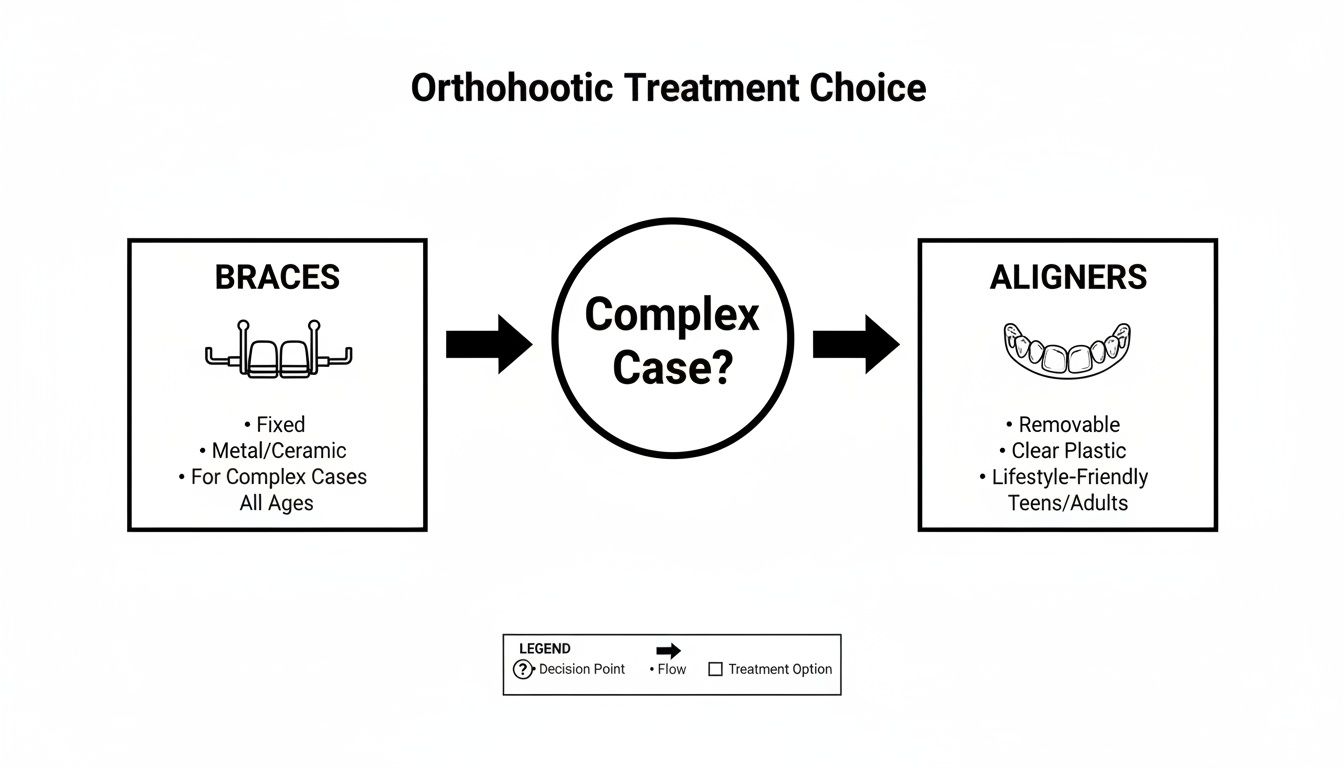
As you can see, braces are often the go-to for more severe orthodontic work. On the other hand, aligners have become the top choice for people who value aesthetics and want something that fits easily into their daily routine.
At a Glance Comparing Braces and Clear Aligners
To make the decision clearer, it helps to see the main differences laid out side-by-side. While some aligner brands can be just as pricey as braces, newer models like Toothfairy are making this advanced treatment a smarter and far more affordable way to straighten your teeth.
Clear aligners are now the top orthodontic choice for adults across the UK. In fact, 78% of users report high
\satisfaction, mainly because they’re so discreet and don’t get in the way of everyday life.
This table gives you a quick snapshot of what you can expect from each option.
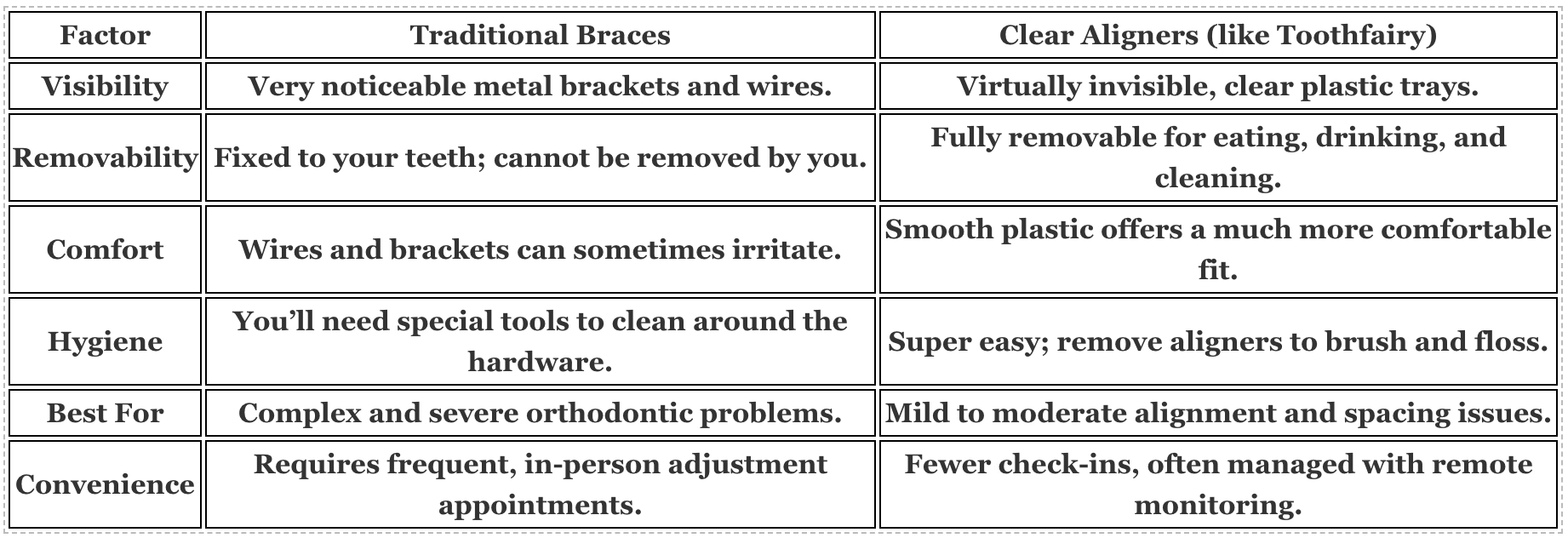
Ultimately, both paths lead to a straighter smile, but the journey is quite different. The table highlights that your decision will likely hinge on your clinical needs versus your lifestyle priorities.
How Do Teeth Actually Move? A Look at the Mechanics
Before we can really compare braces and aligners, it’s worth getting to grips with the science of how teeth move in the first place. While both treatments get you to the same destination—a straighter smile—they take very different routes to get there. One is a fixed, powerful system that pulls, while the other is a modern, progressive method that pushes.
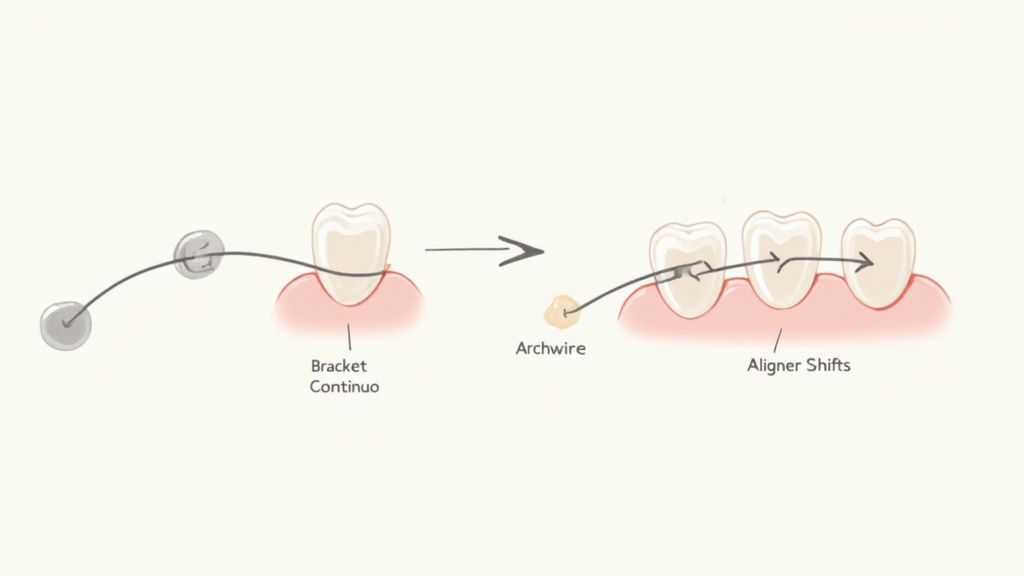
This whole process is called bone remodelling. It sounds dramatic, but it’s just biology at work. The gentle, constant force from braces or aligners tells cells in your jawbone to get busy. They break down tiny bits of bone in the path of the moving tooth and build new bone behind it to lock it into its new position. It’s a slow, steady, and perfectly natural process.
The Push-and-Pull System of Traditional Braces
Think of traditional braces as a tiny, intricate engineering project bonded directly to your teeth. It’s a system of interconnected parts that work together to apply consistent, controlled force.
- Brackets: These are the small metal or ceramic squares glued to the front of each tooth. They’re essentially handles for the archwire to grab onto.
- Archwire: This is the thin metal wire threaded through each bracket, connecting all the teeth. The archwire is the real workhorse; it’s pre-shaped and, as it tries to return to that original form, it gently pulls the teeth along with it.
- Elastics (Ligatures): You’ll know these as the tiny rubber bands that hold the archwire firmly in the bracket slots.
You’ll visit your orthodontist for regular appointments, usually every 4-6 weeks, where they’ll manually tighten or adjust the archwire. This tweak increases the tension, continuing the slow “pulling” motion that guides your teeth into alignment. It’s a powerful method that gives the orthodontist immense control, which is why it’s been the go-to for complex cases for decades.
The core idea behind traditional braces is continuous force applied by a fixed system. Your orthodontist is in the driver’s seat, making precise adjustments that lead to highly predictable results, even for the most stubborn misalignments.
The Progressive Shifting of Clear Aligners
Clear aligners take a completely different tack. Instead of a fixed system that pulls, aligners use a series of custom-made, removable trays that incrementally “push” your teeth into position.
It all starts with a very precise 3D digital scan of your mouth. This scan creates a detailed digital model of your teeth, which your dentist then uses to map out the entire treatment from start to finish. It’s like a digital roadmap, showing every tiny shift your teeth will make along the way.
From this digital plan, a series of custom aligner trays is created. Each tray is just a little bit straighter than your teeth are at that stage. You wear one for about one to two weeks before moving on to the next one in the series, and each tray gently nudges your teeth closer to their final destination.
This approach brings some clever advantages:
- Incremental Force: The pressure is firm but gentle, applied by each new aligner to specific teeth, moving them a fraction of a millimetre at a time.
- Predictable Results: Because the entire treatment is mapped out digitally from the start, the final outcome is very clear and predictable.
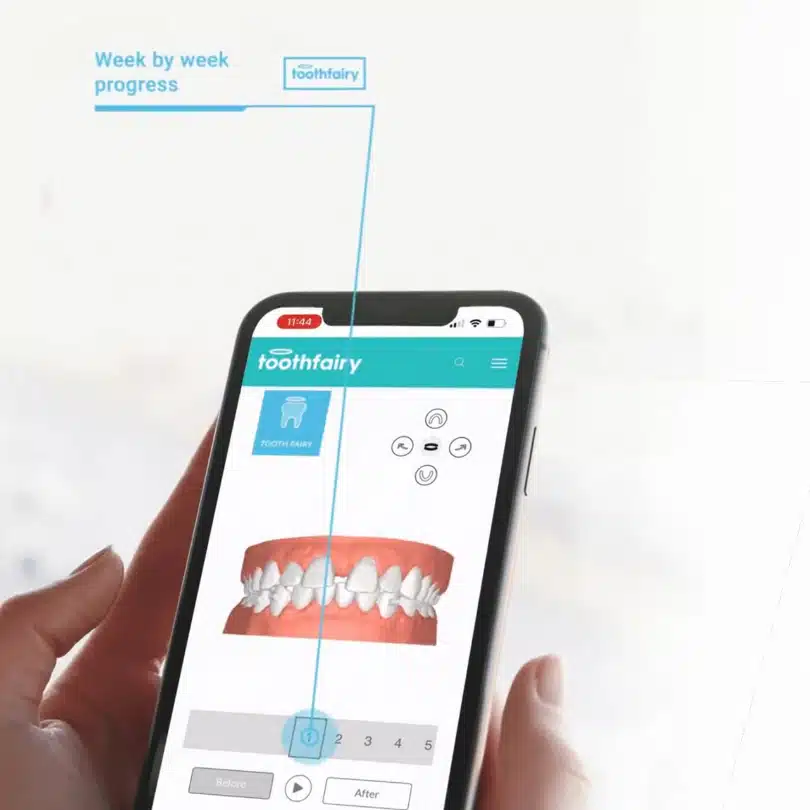
- Modern Convenience: This is where companies like Toothfairy have really leaned into the technology. They offer a smarter way to straighten teeth by pairing aligner treatment with remote monitoring, allowing your dentist to track your progress through an app. This cuts down on the need for constant in-person visits without ever compromising on professional supervision.
It’s a smarter, often more affordable, route to a straighter smile that actually fits into a busy, modern lifestyle. The mechanics are precise, the process is discreet, and the professional oversight is always there.
Timelines and Results: What to Expect from Your Treatment
When you’re choosing between braces and aligners, two questions always come to the front of your mind: “How long will this take?” and “Will it actually work?”. Both options will get you to a straighter smile, but the journey, the timeline, and the types of problems they solve best are quite different.
For decades, traditional fixed braces were the go-to for pretty much any orthodontic issue. They’re still the heavyweights for complex cases. If you’re looking at a treatment time of 12 to 24 months, it’s usually because braces are needed to tackle serious bite problems, severely rotated teeth, or major gaps and crowding. The constant, powerful force they apply is what makes these big moves possible.
Clear aligners, on the other hand, often present a much faster path for many people. Thanks to incredibly precise 3D digital planning, they are brilliant for a huge range of mild to moderate alignment issues. For these common cases, you could be looking at a finished smile in just 6 to 18 months. It’s this efficiency that makes them such a popular choice, especially for adults.
Why Your Commitment Is the Deciding Factor
Here’s the single biggest difference that impacts both your timeline and your final result: compliance. This is where the two methods really show their true colours.
With fixed braces, compliance is basically built-in. The brackets and wires are bonded to your teeth, so they’re working their magic 24/7, whether you think about it or not. This takes self-discipline out of the picture, which is why braces are often a reliable choice for teenagers. Your orthodontist is in the driver’s seat, making adjustments at each appointment.
Clear aligners hand that responsibility over to you. For them to work as planned, you absolutely must wear them for a strict 20-22 hours every single day.
Think of it this way: the success of your clear aligner treatment is directly tied to your commitment. If you get slack and start taking them out too often, you’re not just slowing things down—you could stop your progress entirely, which means a longer treatment and a less-than-perfect result.
How Different Dental Problems Change the Timeline
The complexity of your case is what really dictates how long you’ll be in treatment, no matter which option you go for. Let’s break it down with a few real-world examples.
- Scenario 1: Minor Crowding: Got a few slightly crooked front teeth? Clear aligners can often sort that out beautifully in as little as six months. While braces could do the job too, the process might feel a bit more involved and could take longer.
- Scenario 2: Gaps and a Mild Bite Issue: If you have noticeable spacing and a slight overbite, a clear aligner treatment might take around 12-18 months. Modern systems use small, tooth-coloured attachments and even rubber bands to handle these more complex movements with impressive precision.
- Scenario 3: Severe Overbite or Rotations: For really significant bite problems or teeth that are severely twisted out of place, fixed braces are often the most predictable and effective tool. In these situations, you’d be looking at a timeline closer to the 24-month mark, as that continuous force is needed to make such big changes.
The bottom line is that treatment duration and compliance are where you’ll see a major split. UK clear aligners often get the job done faster (6-18 months) compared to the typical 12-24 months for braces, largely due to that precise 3D planning. But fixed braces guarantee 100% wear time, making them a sure bet for complex cases.
Interestingly, this rigidity can have its downsides; satisfaction rates for braces hover around 85%, often pulled down by their appearance and the hassle of breakages. Aligners flip the script—they demand discipline, but UK user surveys show 78% are thrilled with their results, putting huge value on being able to remove them. You can dive deeper into the pros and cons of clear aligners vs braces with insights from our experts.
This is where modern solutions like Toothfairy are changing the game. By using remote monitoring, your dentist can keep a close eye on your progress virtually. It helps bridge that compliance gap, making sure you’re on track without constant trips to the clinic and keeping you actively involved in creating your new smile.
How Orthodontic Treatment Impacts Your Daily Life
Choosing how to straighten your teeth is about more than just the end result; it’s a decision that will weave itself into every meal, conversation, and morning routine you have for months or even years. The real difference between braces and clear aligners isn’t just clinical—it’s felt in these everyday moments.
Your choice will directly shape your lifestyle for the entire treatment period. It influences everything from what you eat for lunch to how you feel about smiling in photos.
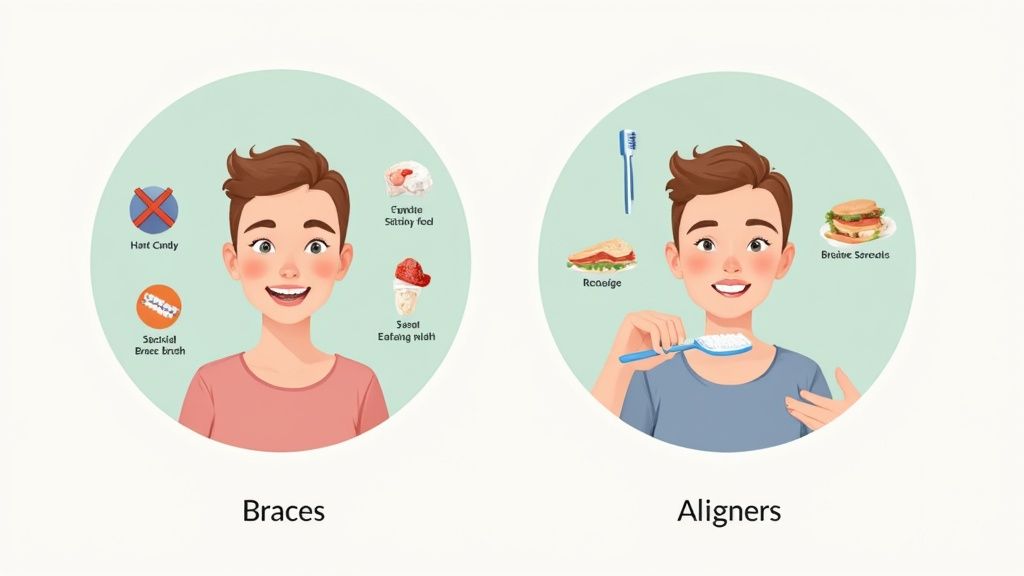
This is where you need to be honest with yourself about what you’re willing to adapt to. Are you prepared for a complete overhaul of your diet and hygiene habits? Or do you need a solution that fits seamlessly into your current life? Let’s break down the real-world impact of each option.
Daily Life with Traditional Braces
Living with fixed braces demands a constant, conscious adjustment. Because the brackets and wires are cemented to your teeth, they require a new level of attention throughout the day, every single day.
The most immediate change you’ll notice is your diet. Your orthodontist will hand you a list of forbidden foods right from the get-go, which almost always includes:
- Hard Foods: Things like nuts, hard sweets, and even crunchy apples can easily bend wires or pop off a bracket.
- Sticky Foods: Toffee, caramel, and chewy sweets are notorious for getting tangled in your hardware and being a nightmare to clean out.
- Tough Foods: Even chewing on tough meats or a crusty roll can put your braces at risk.
Beyond food, your oral hygiene routine becomes far more involved. Simple brushing and flossing just won’t cut it anymore. You’ll need an arsenal of special tools like interdental brushes and floss threaders to navigate around the wires and clean your teeth effectively. This whole process can easily take two to three times longer than your old routine.
Then there’s the comfort factor. The metal can sometimes irritate the inside of your cheeks and lips, and many people feel self-conscious about the visible hardware, especially in professional or social settings.
The Clear Aligner Lifestyle Advantage
This is exactly where clear aligners change the game. They were designed specifically to overcome these daily hurdles, and their defining feature is that they are completely removable. This gives you a level of freedom that fixed braces simply can’t match.
Being removable means your day-to-day life remains largely unchanged. You take your aligners out for meals, so there are absolutely no dietary restrictions. You can carry on enjoying all your favourite foods without a second thought about damaging your orthodontic appliance.
The ability to remove aligners for eating and cleaning isn’t just a minor convenience—it’s a fundamental lifestyle benefit. It eliminates the daily stress and limitations that come with fixed hardware, making the entire teeth-straightening journey feel far less intrusive.
Oral hygiene is also refreshingly straightforward. You just pop the aligners out, brush and floss your teeth as you normally would, and give the trays a quick clean before putting them back in. There are no obstacles, no special tools, and no frustrating minutes spent trying to get food out from behind brackets. This is a massive reason why modern, affordable solutions from providers like Toothfairy are so popular—they deliver professional results without demanding a complete overhaul of your daily habits.
This dramatic difference in daily experience is a huge driver behind the trends we’re seeing in the UK. The clear aligners market is projected to surge from USD 290.6 million in 2024 to an incredible USD 1,368.1 million by 2030. Adults, who make up a huge 73.92% of this market, are overwhelmingly choosing subtle treatments that fit their professional lives. This preference is reflected in patient satisfaction, with surveys showing 78% of UK aligner users reporting high satisfaction compared to just 62% for braces, largely due to the convenience and lack of food restrictions. You can find more insights about these orthodontic trends in the UK online.
A Financial Breakdown of Orthodontic Costs in the UK
Investing in your smile is a huge decision, and let’s be honest, the financial side of things is a major part of that. When you’re weighing up braces against clear aligners, the price tag is often the first thing people look at. But to get the full picture, you need to think beyond the initial quote and consider the total investment.
At first glance, traditional metal braces might seem like the cheaper option, typically setting you back somewhere between £2,500 and £6,500 in the UK. The final figure really hinges on how complex your case is and how long the treatment will take. Certain clear aligner brands can command a similar or slightly higher range, from £3,000 to £5,500. But the upfront cost doesn’t tell the whole story, and the gap between them is getting smaller all the time.
What Is Included in the Price Tag
When you get a quote for orthodontic work, it’s vital to know exactly what you’re paying for. A good, comprehensive plan should be about more than just the appliance itself.
Make sure your quoted price for either braces or aligners covers:
- Initial Consultation and Records: This is your first assessment, plus all the necessary X-rays, photos, and 3D digital scans or old-school moulds.
- The Appliance Itself: For braces, that’s all the brackets, wires, and bands. For aligners, it’s the complete set of custom-made trays.
- All Scheduled Appointments: This means the initial fitting, regular wire-tightening visits for braces, and progress checks for aligners.
- Post-Treatment Retainers: The first set of retainers to keep your teeth in their new position should absolutely be part of the deal.
- Any Necessary Refinements: Sometimes, tiny adjustments are needed at the end to really nail the result.
Asking for a clear breakdown means no nasty surprises later on and helps you compare different offers like for like.
Uncovering the Hidden Costs of Treatment
This is where the real financial difference between braces and aligners starts to show. While braces might occasionally have a lower initial quote, they often come with “hidden” costs that can really add up.
The biggest one? Your time. Getting traditional braces means frequent trips to the clinic for manual adjustments, usually every 4-6 weeks. Each visit means booking time off work, factoring in travel costs, and sitting in the waiting room. And if a bracket snaps or a wire pokes out, that’s another emergency appointment you have to squeeze in.
Clear aligners, especially when managed by modern providers like Toothfairy, slash these indirect costs. By using remote monitoring, a qualified dentist tracks your progress through an app, which can cut down your need for routine clinic visits by up to 50%. You’re not just saving money on petrol and parking; you’re saving valuable time you could be spending on literally anything else.
The cost differences between braces and aligners in the UK highlight this narrowing gap. While metal braces average £2,500 to £6,500, clear aligners from brands like Invisalign can command £3,000 to £7,000. This reflects advantages like fewer clinic visits, as no wire adjustments are needed. The good news is that payment plans are now standard, with 100% of major UK providers offering them, putting treatment within reach for the 70% of adults looking for a better smile. To get a deeper understanding, you can discover more insights about UK orthodontic costs and see the full picture.
Making Your Smile Affordable with Toothfairy
We firmly believe that a confident, healthy smile shouldn’t break the bank. Our approach at Toothfairy is built on an efficient, tech-first model with remote supervision from qualified UK dentists. This lets us cut the overheads that come with running traditional clinics.
The result? We can offer a smarter, more affordable way to get professionally supervised clear aligner treatment, without ever cutting corners on the quality of your care. We also provide flexible payment plans to spread the cost, making it a manageable investment in yourself.
Choosing the Right Path to a Straighter Smile
Deciding between braces and aligners isn’t about picking a “winner.” It’s about matching the right tool to your specific dental needs and, just as importantly, to your lifestyle. We’ve looked at how they work, how long they take, and what they cost, so now the picture should be much clearer.
This choice will define your daily experience for the next several months, so let’s tie it all together. The goal is to help you make a smart, confident decision that you’ll be happy with long after your treatment is finished.
A Final Look at Your Two Options
Let’s quickly recap the fundamental difference. Traditional braces are a fixed, powerful system. They’re fantastic for tackling severe, complex dental issues because they work non-stop, 24/7. For major transformations, their reliability is hard to beat.
Clear aligners, on the other hand, offer a modern, flexible route. They are designed for convenience—discreet, comfortable, and removable. This makes them a brilliant option for adults and teens with mild to moderate alignment problems who don’t want their treatment to disrupt their day-to-day lives.
The best orthodontic solution fits your life, not the other way around. While the most complex cases still need the heavy-lifting power of fixed braces, a huge number of people can get the results they want with the freedom and subtlety of clear aligners.
Which Scenario Sounds Like You?
To make the choice even more straightforward, let’s consider a few real-world situations. See which one fits you best.
- You have major bite problems or severely rotated teeth: If you’re dealing with a significant overbite, underbite, or teeth that are very twisted, traditional braces are probably the most predictable route. The constant, high-level force they provide is purpose-built for these kinds of major structural adjustments.
- You’re a working professional with mild crowding or gaps: Clear aligners are almost certainly your best bet. They’re nearly invisible, so you can go about your professional life without feeling self-conscious in meetings. Plus, being able to pop them out for meals or a work event gives you total freedom.
- You’re a teen who is diligent and cares about aesthetics: You’re likely an ideal candidate for clear aligners. The only catch is commitment—you have to be disciplined enough to wear them for the required 20-22 hours a day. If you can do that, you get the smile you want without all the metal.
The Modern, Intelligent Choice
For most people in the UK looking to simply improve their smile, the combination of convenience, comfort, and aesthetics makes clear aligners the standout choice. This is exactly where a service like Toothfairy comes in, offering an intelligent, modern approach.
We offer a smarter way to straighten your teeth by bringing together professional orthodontic care from UK-registered dentists with the genuine convenience of remote monitoring. By cutting out the overheads of traditional clinics, our model is designed to be more affordable without compromising on the high-quality, personalised treatment you expect. It’s a process designed to fit around your life.
Getting the smile you’ve always wanted is more accessible than you probably think. But the only way to know for certain if clear aligners will work for you is to get a professional opinion.
Why not take the first step today? Explore Toothfairy’s free assessment to check your suitability and see just how simple it is to begin your journey to a more confident smile.
Your Questions Answered: Braces vs. Aligners
When you’re trying to decide on the best way to straighten your teeth, it often boils down to a few practical, day-to-day questions. Getting clear answers on these points can make all the difference, helping you see which option truly fits your life.
Here are some of the most common queries we hear from patients, with straightforward answers to help you choose.
Do Clear Aligners Hurt?
This is probably the number one question on everyone’s mind. While no teeth-straightening method is completely sensation-free, clear aligners are definitely on the gentler end of the spectrum. Most people describe the feeling as a mild, firm pressure, which you’ll notice most in the first day or two after switching to a new tray.
That pressure is a good thing—it means the aligners are doing their job and gently shifting your teeth. It’s a far cry from the soreness that can follow a wire-tightening appointment for braces, or the constant risk of brackets and wires rubbing against the inside of your mouth.
Can I Switch from Braces to Aligners Part-Way Through?
Sometimes, yes. It’s what we call a hybrid treatment, and whether it’s an option for you really depends on your individual case and where you are in your treatment journey.
This approach often works best after traditional braces have done the heavy lifting—tackling the most complex movements. Then, you can switch to clear aligners to handle the finishing touches and fine-tuning. You’ll need a proper consultation with a dentist to see if it’s a smart and effective move for your specific situation.
How Do You Keep Your Teeth Clean?
This is where clear aligners have a massive real-world advantage. Keeping your teeth and gums healthy is just so much easier.
- With Aligners: You just pop them out. Then you can brush and floss exactly as you normally would, with nothing in the way. It’s simple, effective, and lets you reach every surface of your teeth.
- With Braces: Cleaning becomes a bit of an operation. You’ll need special tools like interdental brushes or floss threaders to meticulously work around all the brackets and wires. It takes time, patience, and it’s still tough to do a perfect job.
The ease of cleaning with removable aligners isn’t just about convenience—it’s a huge plus for your oral health. It dramatically lowers the risk of plaque build-up, staining, and cavities, which are common headaches for people with fixed braces.
Is Remote Monitoring as Safe as Seeing a Dentist in Person?
Absolutely. When done correctly, like the system we use at Toothfairy, remote monitoring is a perfectly safe and highly effective way to manage your treatment. Our entire process is built around ensuring a qualified UK dentist is overseeing your journey from start to finish.
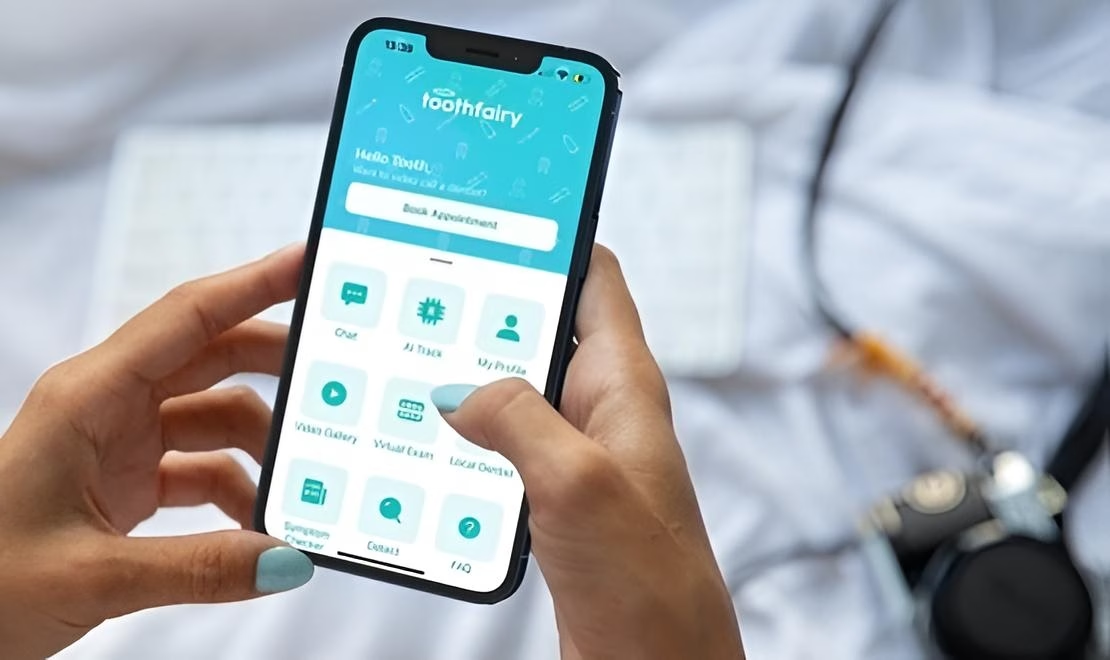
You’ll use an app to send in regular scans of your teeth, which your dedicated dentist personally reviews to track your progress. They check every detail to make sure your teeth are moving exactly as predicted and can spot any potential issues long before they become problems. If something ever needs a physical check, they’ll arrange it. For the most part, though, this virtual supervision is both incredibly safe and a massive time-saver. It’s a modern approach that puts expert care right at your fingertips.
Ready to see if a smarter, more convenient way to straighten your teeth is right for you? With Toothfairy, you can get the smile you’ve always wanted with professional supervision from UK-registered dentists, all at an affordable price.
Take the first step with our free online assessment today at https://www.toothfairyapp.co.uk.
Last updated on December 15, 2025

Toothfairy Care Team
Toothfairy, is the world's smartest dental app, that connects patients to a dentist for a range of issues, from emergencies, cosmetics, prescriptions to virtual exams.
Toothfairy Care Team
Toothfairy, is the world's smartest dental app, that connects patients to a dentist for a range of issues, from emergencies, cosmetics, prescriptions to virtual exams.