What Do Retainers Do to Keep Your Perfect Smile Safe
After pouring so much time and effort into getting your teeth perfectly straight, the final piece of the puzzle is your retainer. Its job sounds simple, but it’s absolutely vital: it holds your teeth in their new positions once your braces or clear aligners come off.
This step is what stops them from drifting back to where they started.
Why Retainers Are Your Smile’s Best Friend
Think about it this way: after your orthodontic treatment, the bone and ligaments holding your teeth are a bit like freshly set cement. The teeth are in the right spot, but the foundation around them is still soft and needs time to firm up. Your retainer acts as a scaffold, keeping everything locked in place while that foundation hardens.
Without that support, your teeth will almost certainly start to move. This isn’t a sign that your treatment didn’t work; it’s a natural process called orthodontic relapse. Your body’s tissues, especially the periodontal ligaments, have a “memory” and will try to pull your teeth back to their old, familiar spots. Your retainer is the only thing standing in their way.
Here’s a quick breakdown of exactly what a retainer does for you.
Retainer Functions at a Glance
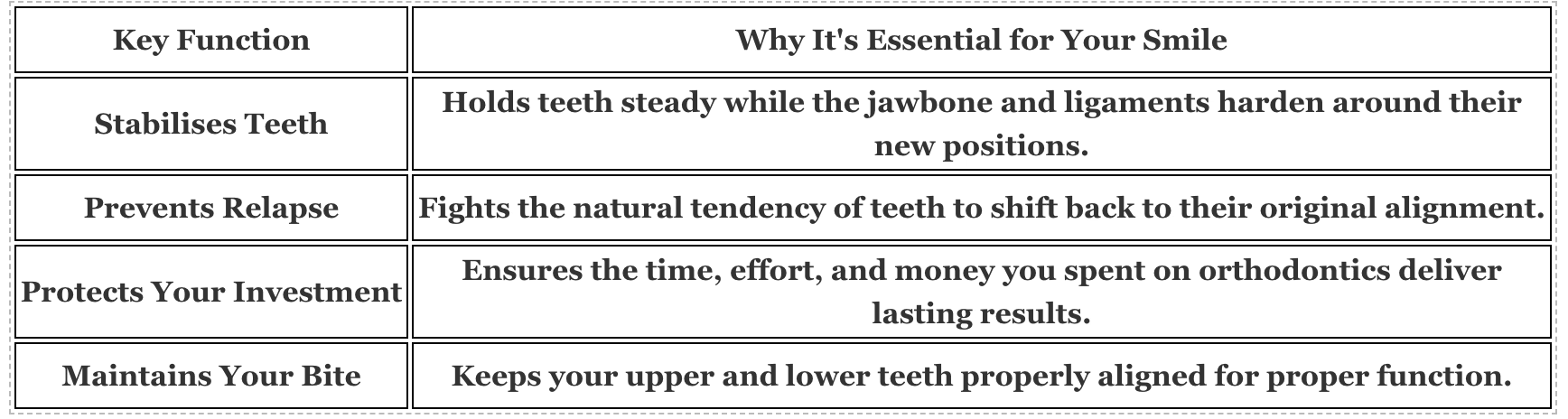
Ultimately, wearing your retainer is how you protect the investment you’ve made in your smile.
Protecting Your Investment
Following your orthodontist’s instructions on wearing your retainer is the single most important thing you can do to keep your smile looking great. Neglecting it can undo months, or even years, of hard work. That’s why consistent wear is completely non-negotiable.
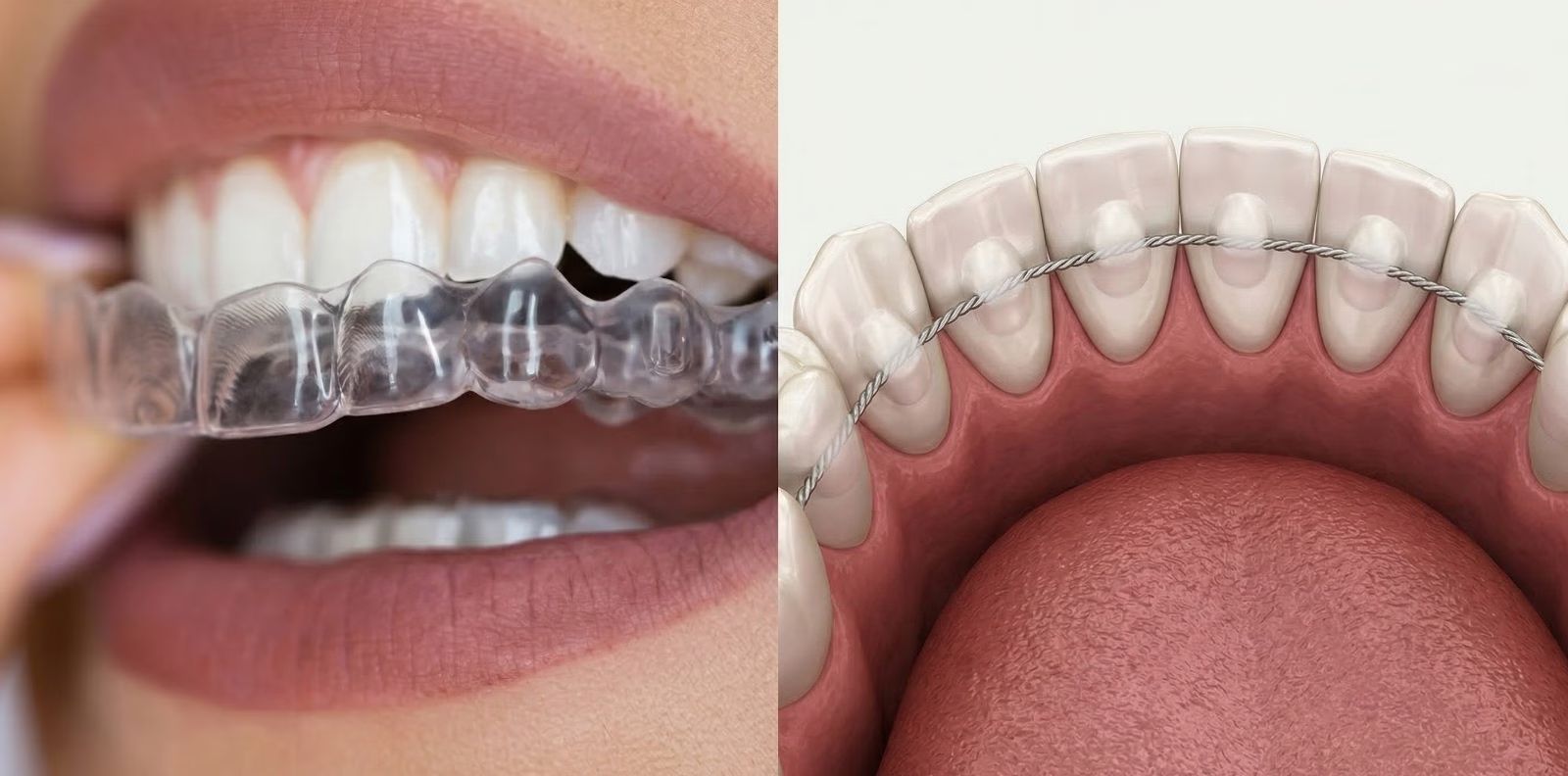
There are a few different types of retainers out there, and while they look different, they all do the same fundamental job. Whether it’s a fixed wire hidden behind your teeth or a clear, removable tray you pop in at night, the goal is always the same: maintaining that perfect alignment you worked so hard for.
By wearing a retainer, you are actively preventing orthodontic relapse and ensuring the results of your treatment last a lifetime. It’s the final, and most vital, phase of your journey to a permanently straight smile.
Thankfully, looking after your smile for the long haul is easier and more affordable than ever. Services like Toothfairy make getting expert advice, check-ups, and even replacement retainers incredibly straightforward. As a smarter way to manage your dental care, you can handle everything right from your home here in the UK, making sure your smile stays perfect for years to come.
Fixed vs. Removable Retainers: Which One Is Right for You?
So, you’ve done it. Your teeth are beautifully straight, and the hard work has paid off. But now comes the most important part of the journey: keeping them that way. This is where retainers come in, and you’ll likely be choosing between two main types – fixed or removable.
Each has its own unique way of protecting your smile, so let’s break down which one might be the best fit for your life.
The Case for Fixed Retainers
Think of a fixed retainer as your smile’s permanent bodyguard. It’s a very thin, discreet wire that your dentist bonds to the back of your teeth, usually the lower front ones. Because it’s cemented in place, you can’t see it, and it works around the clock to stop your teeth from moving.
This “set it and forget it” approach is brilliant if you’re worried about losing a retainer or simply forgetting to put it in. It offers constant, reliable protection. The downside? It demands a bit more attention when it comes to cleaning. You’ll need to learn how to floss around the wire, often with tools like floss threaders, to keep plaque from building up.
The Flexibility of Removable Retainers
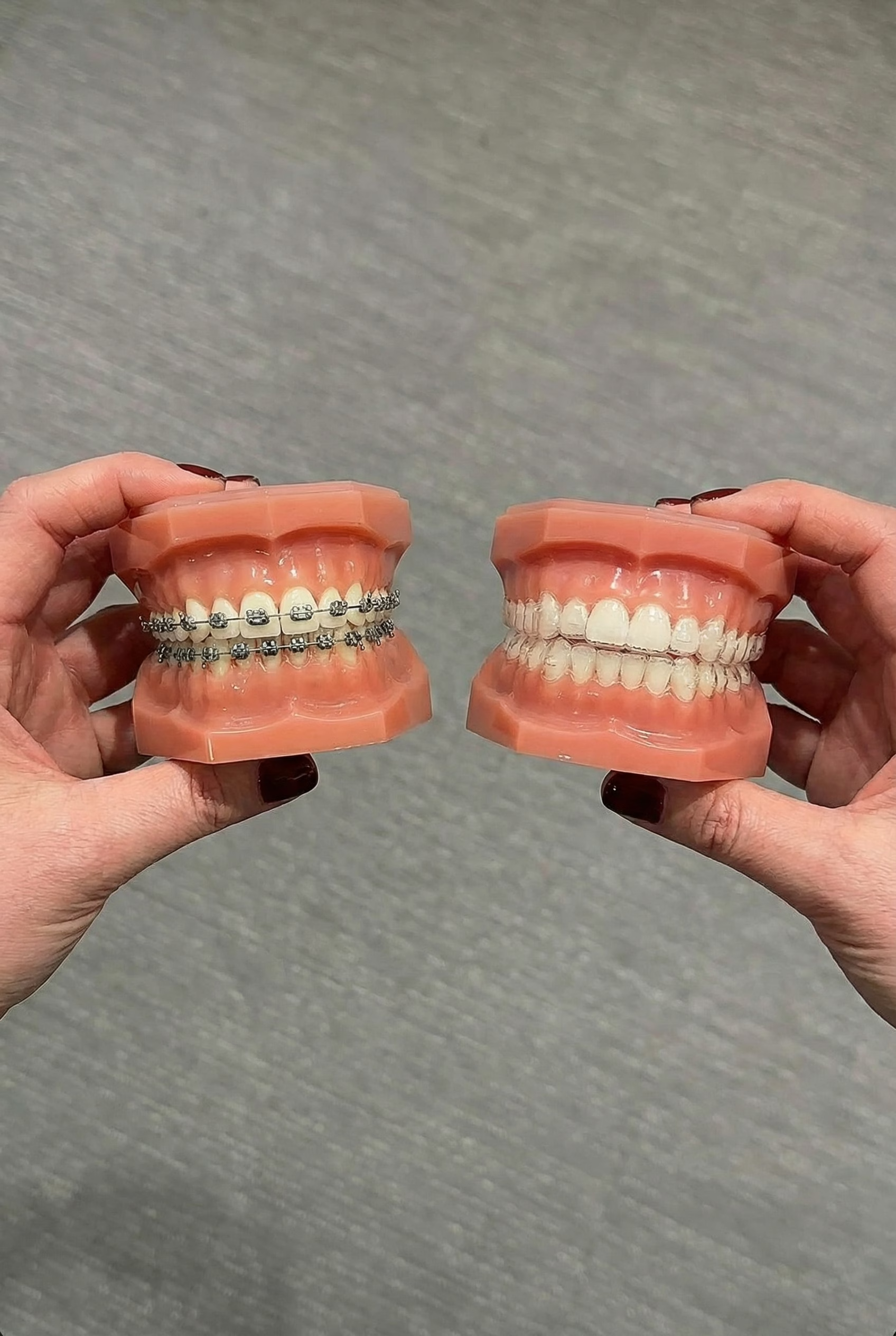
Removable retainers are incredibly popular, especially for anyone who has just finished treatment with clear aligners. The most common type you’ll see is the Essix retainer – a clear, custom-moulded tray that fits perfectly over your teeth. It looks almost identical to the aligners you might have worn during your treatment with a provider like Toothfairy.
There are some clear benefits to this style:
- Effortless Cleaning: You simply pop the retainer out to brush and floss your teeth normally. Cleaning the retainer itself is also a breeze.
- Total Freedom for Meals: Just take it out before you eat or drink anything other than water. No food restrictions, no hassle.
- A Discreet Look: Because they’re transparent, they are nearly invisible, which is great if you value a subtle appearance.
The real power of a removable retainer lies in its convenience. But remember, it only works if you wear it. Your commitment is what makes it effective.
This simple flowchart really drives home the point.
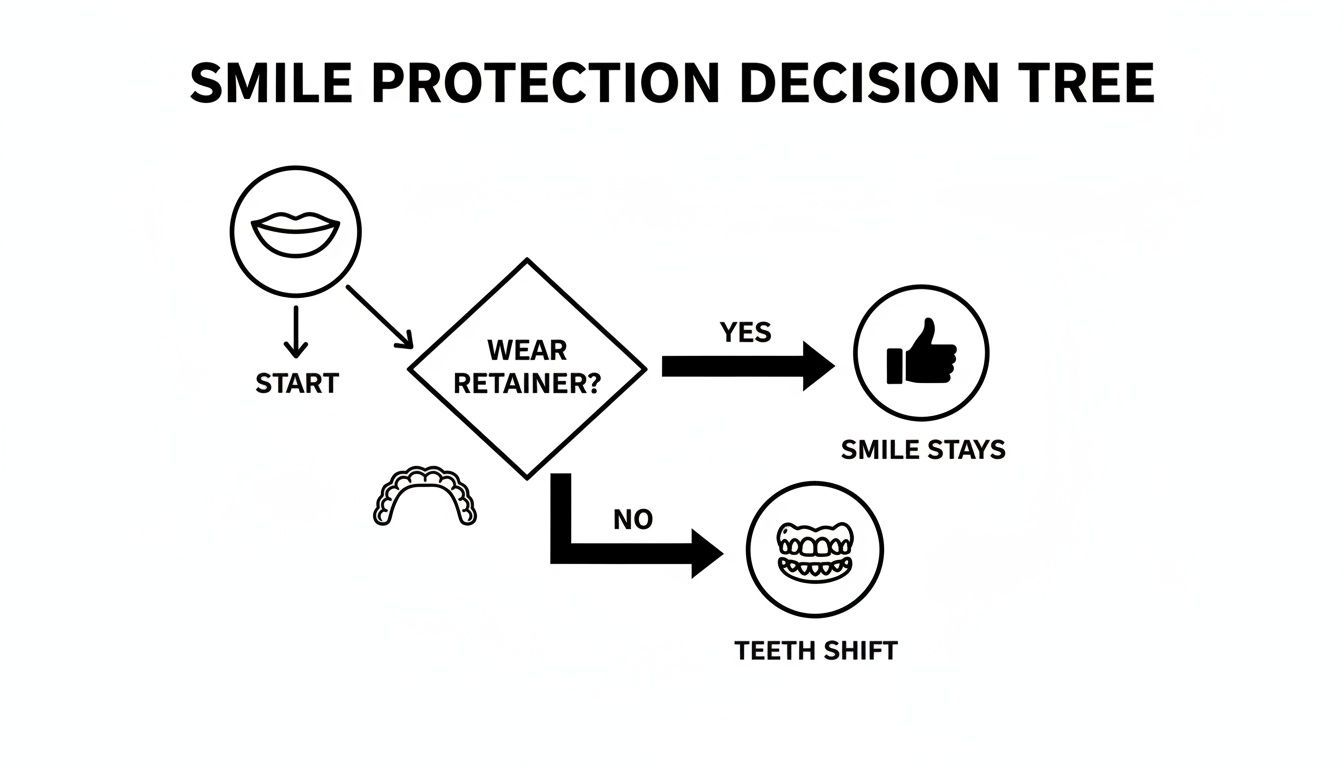
As you can see, wearing your retainer consistently is the only guaranteed way to lock in that perfect alignment for the long haul.
Interestingly, we’ve seen a major shift in preferences over the years. Worldwide, retainers are credited with preventing a staggering 50-90% of orthodontic relapse. Here in the UK, the trend is even more noticeable. Before 2010, fixed retainers were the go-to, making up about 70% of cases. Now, removable options have surged in popularity, capturing around 60% of the market.
This change is largely down to hygiene. Being able to remove your retainer makes cleaning so much easier, which can reduce the risk of decay by an estimated 35%. If you’re curious about the data, you can read more about the UK orthodontic supplies market on Spherical Insights.
The Science Behind Why Teeth Shift Back
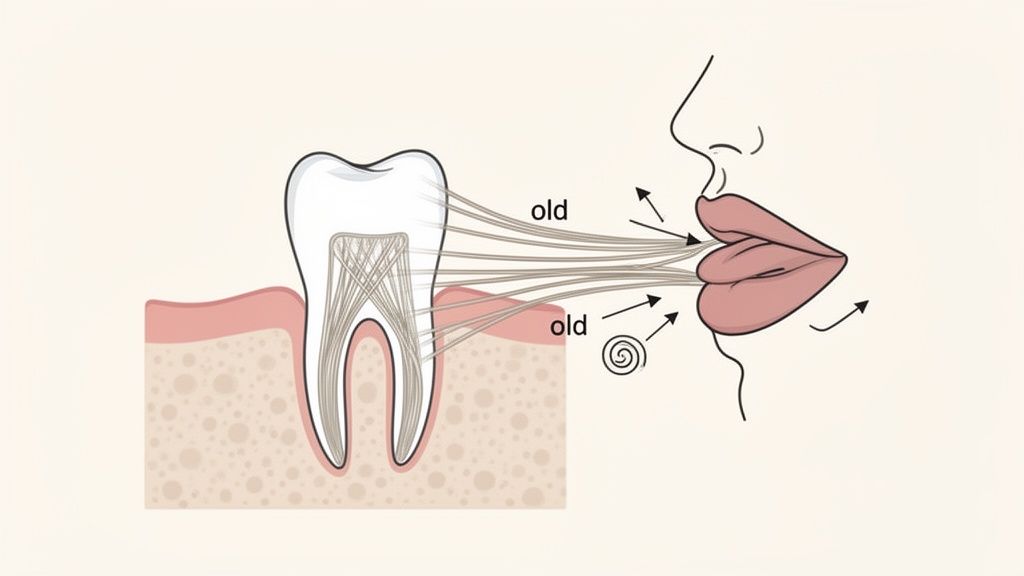
It’s a tough thought, isn’t it? After all those months or even years of dedication with braces or clear aligners, your teeth might just decide to shift back. This isn’t a sign that your treatment failed; it’s simply your body doing what it naturally does. Getting to grips with the science behind this process, called orthodontic relapse, is the first step to understanding why retainers are so important.
Your teeth aren’t cemented into your jawbone. They’re actually held in place by a clever network of tiny, elastic fibres known as periodontal ligaments. Think of them as microscopic bungee cords that have a stubborn “memory” of where your teeth used to be.
When you straighten your teeth, these ligaments are stretched and put under tension. The moment the pressure from your braces or aligners is gone, their natural tendency is to snap back, pulling your teeth along with them. This is the main reason we need retainers—to hold everything steady against that pull.
The Forces Working Against Your Smile
It’s not just those springy ligaments you have to worry about. Several other natural forces are always putting a gentle but constant pressure on your newly aligned smile.
These include:
- Pressure from your tongue: Every time you speak or swallow, your tongue pushes against your teeth.
- Lip and cheek muscles: The muscles in your face create a subtle inward pressure on your dental arch.
- Jaw growth and ageing: As we get older, our jaws naturally change, and this can lead to gradual tooth movement.
On their own, these forces might seem tiny. But add them all up over weeks and months, and they have more than enough power to cause noticeable shifting.
A retainer is essentially your smile’s bodyguard. It holds your teeth firmly in their new, correct positions, giving your bone and ligaments the time they need to settle in and adapt. This remodelling process can take many months to complete.
This is exactly why wearing a retainer isn’t just a suggestion—it’s a lifelong commitment to protecting your investment. In the UK, orthodontic retainers are the key to keeping teeth straight, especially when studies show relapse can affect up to 70% of patients who don’t follow a proper retention plan. Without a retainer, your teeth could easily start shifting back within just 6-12 months. If you’re interested in the specifics, you can find more details in this report on the UK orthodontics market from Market Research Future.
Keeping up with your retainer schedule is non-negotiable. Modern services like Toothfairy’s virtual check-ins can make it easier to stay on track, helping you avoid the frustration and expense of needing to straighten your teeth all over again.
Right, you’ve finally finished your orthodontic treatment. The braces are off, or you’ve used your last aligner. Now comes the one question on everyone’s mind: “So, how long do I really have to wear this retainer?”
The honest answer? For as long as you want your teeth to stay straight. It’s that simple. Think of it less like a temporary chore and more like a permanent part of your dental care, just like brushing your teeth before bed. Your teeth have a stubborn memory and, without a retainer to hold them in place, they’ll almost always try to creep back to their old positions.
From Full-Time to Night-Time Wear
Don’t worry, you won’t be wearing it 24/7 forever. Your retainer journey usually starts with a more intensive schedule. For the first few months after treatment, your dentist will likely ask you to wear your removable retainer full-time. You’ll only take it out to eat, drink anything other than water, and brush your teeth.
This initial period is critical. The bone and soft tissues around your newly straightened teeth are still soft and need constant support to firm up and stabilise in their new spots.
After a few months, once your dentist sees that things have settled nicely, you’ll get the go-ahead to switch to night-time wear. This is the long-term plan – just pop your retainer in before you go to sleep. Sticking to this schedule for life is what keeps your smile looking just as good as it did on the day your treatment ended.
Lifelong nightly wear is the only proven way to guarantee your smile stays put. It’s a tiny commitment that pays off with a lifetime of confidence in your straight teeth.
Making It Part of Your Routine
The easiest way to stick with it is to build it into your nightly habits so you don’t even have to think about it.
- Keep it with your toothbrush: Put your retainer case right next to your toothbrush. After you brush your teeth at night, putting your retainer in becomes the next logical step.
- Set an alarm: For the first few weeks, a nightly reminder on your phone can be a massive help until the habit feels completely automatic.
- Use a little tech help: Tele-dental services like Toothfairy can be brilliant for this. Their app can send you reminders, making long-term care feel effortless and giving you a direct line to a dentist if you ever run into any issues.
Following this advice is more important than you might think. After treatment with clear aligners, 90% of UK patients are told to wear their retainers nightly for life to stop their teeth from moving back. Without proper retainer use, this relapse can happen in up to 80% of cases.
Studies show that even 75% compliance is often enough to keep everything perfectly stable. Yet, people forgetting or stopping their retainer wear leads to an estimated £300 million in re-treatment work across the UK dental industry each year. To dig deeper into the industry side of things, check out the orthodontic retainers market analysis on the Data Bridge Market Research website.
A Simple Guide to Retainer Care and Cleaning
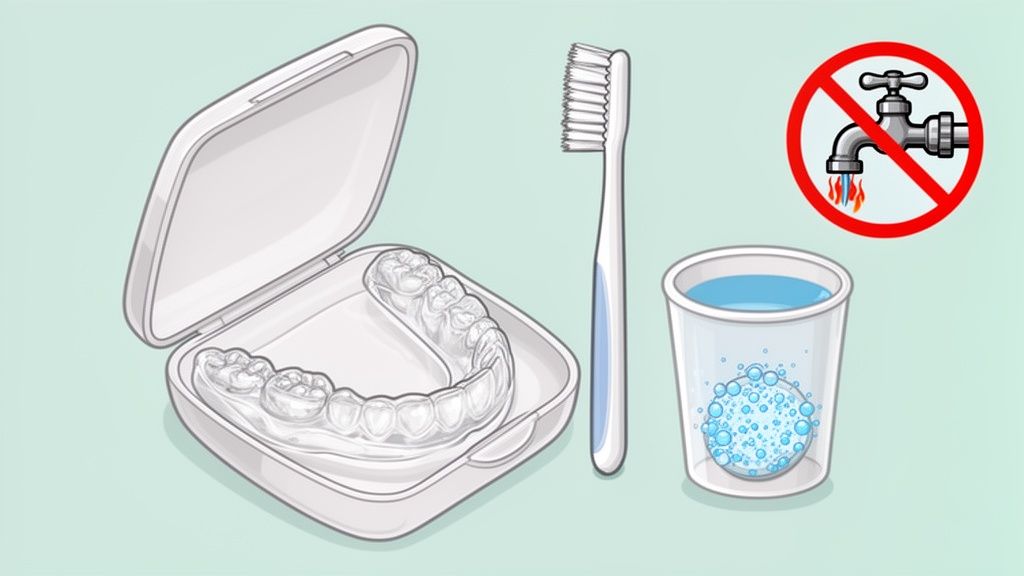
Keeping your retainer clean is every bit as important as remembering to wear it. Think about it—your retainer sits against your teeth for hours at a time. If it’s dirty, it can become a breeding ground for bacteria, leading to everything from bad breath to gum irritation. The good news is that looking after it is straightforward once you get into the swing of things.
Of course, how you clean it depends entirely on whether you have a removable or a fixed retainer. Each one needs a slightly different touch to keep both it and your smile in fantastic shape.
Cleaning Your Removable Retainer
Whether you have a clear plastic Essix-style retainer or a classic Hawley, daily cleaning is a must. A quick rinse under the tap just won’t cut it against the invisible film of plaque and bacteria that builds up.
Here’s a simple routine to adopt:
- Rinse Immediately: The moment you take it out, give your retainer a rinse with lukewarm water. This gets rid of saliva and any fresh plaque before it has a chance to harden into stubborn tartar.
- Brush Gently: Grab a soft-bristled toothbrush (a separate one from your regular brush) and use a small drop of non-abrasive, unscented soap or washing-up liquid. Carefully brush all the surfaces, inside and out, to clear away any film.
- Rinse Again: Once you’re done brushing, rinse it thoroughly under cool or lukewarm water until every trace of soap is gone.
A crucial tip: Never use hot water. The heat can permanently warp the plastic, ruining the custom fit of your retainer and making it completely useless. It’s also wise to avoid abrasive toothpastes, which can create microscopic scratches on the surface—perfect hiding spots for bacteria.
Maintaining a Fixed Retainer
A fixed retainer, bonded to the back of your teeth, obviously needs a different approach since it’s not going anywhere. The main challenge here is cleaning around the thin wire and the points where it’s bonded to your teeth, as this is where plaque loves to accumulate.
Mastering your oral hygiene routine is key. It can feel a bit tricky at first, but learning how to manage tasks like flossing with a permanent retainer is essential for preventing plaque buildup and gum problems. Tools like floss threaders or tiny interdental brushes are your best friends here; they can get into the small spaces your regular toothbrush can’t reach.
Storing Your Retainer Safely
This rule is simple: if your removable retainer isn’t in your mouth, it should be in its case. No exceptions. Leaving it on a napkin at lunch or on your bedside table is a recipe for disaster. This one habit can save it from being accidentally thrown away, crushed, or becoming a chew toy for a curious pet.
Losing or breaking a retainer isn’t just a hassle; it’s a costly mistake that puts all that hard work on your smile at risk. If the worst happens and you do lose or damage it, services like Toothfairy can be a real lifesaver. They offer a quick and affordable way to get a replacement sorted out from home, making sure your teeth don’t get a chance to start shifting back.
Dealing With Common Retainer Hiccups
Let’s be realistic—even when you’re careful, things can happen with your retainer. It might go missing, crack, or just suddenly stop feeling right. The key is not to panic. Most of these little problems have straightforward solutions, and acting quickly is the best way to protect that smile you’ve invested so much time and effort in.
Probably the most frequent issue is a lost removable retainer. If your retainer vanishes, contact your dentist or orthodontist straight away. It only takes a few days for your teeth to start heading back to their old positions, so you really don’t have time to spare. Waiting could mean undoing months of progress.
What to Do When It Feels Like a Dental Emergency
Some retainer problems feel more urgent and can’t always wait for the next available clinic appointment. Whether it’s a wire snapping on your fixed retainer or your removable one getting lost or damaged, you need to know what to do.
Here’s a quick rundown of how to handle these situations:
- Lost or Broken Retainer: Don’t put it off. You need to get a replacement sorted as soon as possible to stop your teeth from moving.
- Retainer Feels Way Too Tight: This is usually a sign you haven’t been wearing it as prescribed and your teeth have already shifted a bit. Try wearing it more consistently, but if it’s genuinely painful or just won’t go in, you need to speak to a professional.
- A Fixed Wire is Causing Discomfort: If the bonded wire feels sharp or has come away from a tooth, it can be really irritating for your tongue and gums. A small piece of orthodontic wax can provide temporary relief by covering the sharp bit.
When these things happen, the stress of waiting for an in-person appointment can be frustrating, especially when you know your teeth could be shifting with every passing day. Getting professional advice immediately is always the best move.
This is where a more modern approach can be a real lifesaver. Instead of waiting around, you could use an app like Toothfairy to have a video call with a UK-based dentist almost instantly. They can take a look, give you clear advice on the spot, and even sort out a replacement retainer to be made and sent directly to you, often more affordably and without the fuss of an emergency clinic visit. It’s a much smarter way to tackle dental problems without delay.
Your Retainer Questions, Answered
Once your orthodontic treatment is done, you’re bound to have questions about the next phase: retention. It’s a crucial part of the journey. Let’s clear up some of the most common queries people have about keeping their brand-new smile perfectly in place.
How Much Do New Retainers Cost In The UK?
The price tag for a new retainer can swing a bit. Generally, you can expect to pay between £100 and £300 per arch for a set of removable retainers from a typical dental practice.
Here at Toothfairy, we build affordable, top-quality retention right into our teeth-straightening packages. This way, you can be sure your new smile is protected from the get-go, without any surprise expenses down the line.
Can A Retainer Fix My Teeth If They Have Moved Back?
This is a common hope, but retainers are really designed to hold teeth in their new position, not to move them. If you’ve noticed a tiny bit of movement, a new retainer might feel quite snug and could gently nudge things back into alignment.
However, for any shift that’s more noticeable, a retainer won’t be enough. You’ll likely need another round of treatment, maybe a short course of clear aligners, to correct it.
The easiest way to get a professional opinion is with a quick video call on the Toothfairy app. A UK-registered dentist can assess the situation and recommend the best course of action, all from the comfort of your home.
What Happens If I Forget To Wear My Retainer?
We’re all human. Forgetting your retainer for a night or two isn’t a disaster, though it will probably feel a little tight when you pop it back in.
The real trouble starts if you stop wearing it for a long time. Your teeth have a natural memory and will almost certainly begin drifting back towards where they started. This is called orthodontic relapse, and it can completely undo the time and effort you put into your treatment.
Consistent nightly wear is the only way to guarantee your smile stays straight for life. Think of it as protecting the investment you’ve made in yourself.
Ready to protect your smile or need expert advice on your retainer? The Toothfairy app connects you with UK dentists instantly for affordable and convenient care. Get started at https://www.toothfairyapp.co.uk.
Last updated on March 18, 2026

Toothfairy Care Team
Toothfairy, is the world's smartest dental app, that connects patients to a dentist for a range of issues, from emergencies, cosmetics, prescriptions to virtual exams.
Toothfairy Care Team
Toothfairy, is the world's smartest dental app, that connects patients to a dentist for a range of issues, from emergencies, cosmetics, prescriptions to virtual exams.